The next morning as we packed, our conversation was limited to practical matters. We flagged down a truck headed past the Rumangabo park headquarters sixty kilometers to the north, and sat quietly on our packs in the flatbed, looking for all the world like an old married couple with nothing left to say. We arrived at the park headquarters around three in the afternoon and asked at the administration office where we could camp that night.
“I’m sorry, but you’re too late,” the man at the desk said. “The group and the guides have already gone up the mountain.”
“I think there’s a misunderstanding,” Vivian said. “We’re seeing the gorillas tomorrow.”
“True, madam. The visit is tomorrow, but it starts early in the morning from a village near the forest’s edge. From here, it’s a three-hour climb, and you need to arrive in the village before sunset. I’m afraid it’s too late to start.”
“No one in Goma told us any of this.”
I watched as Vivian went back and forth with the administrator in French. After an hour, Vivian’s request to speak with the park director paid off. Just before five, he assigned a guide, Etienne, and a porter, Saku, to take us up the mountain to Bukima. As we left, he warned us that the sun would set around six thirty, followed soon after by the evening rains. I don’t know why I thought he might be wrong. The sun sets when it sets.
By six forty-five, it was dark. At seven, it began to drizzle. By seven thirty, it was pouring. We climbed by flashlight along a muddy, slippery path through the rainforest and smallholder farms. One moment, we’d be up to our ankles in mud; the next, we’d slip and fall. Our packs and clothes were caked with mud, and our moods turned foul.
Wir brechen auf Flachland … We set off on flat land. It grows dark and starts to rain. We begin to climb, and the puddles get bigger and deeper, the ground more and more slippery. Parker carries his backpack. Then he slips. And then he falls. Then he swears. Then I slip. Then I slip again and fall. The hill becomes steeper. It’s still raining. Parker falls, again swearing. Saku falls, 2 times, 3 times. After 4 hours we arrive. Parker and I set up our tent in the lean-to where four others are sleeping. We make dinner, fighting rats and each other.
Having had nothing to eat since noon, I set up the stove just outside the lean-to, started boiling water, and added some noodles. We never agreed on what happened next. Whether because of how I set it up or because Vivian bumped it while moving our packs, the pot slid off the stove and rolled down the hill. We stared at it in disbelief.
“You … are … worthless!” Vivian said angrily as our dinner sank into the mud. “I get us up the mountain with no help from you, and you can’t even boil water.”
“What are you talking about? I set up most of the camp and started dinner. You knocked the pot off the stove, not me.”
Our whispered argument grew louder. Someone told us in German to shut up. Then we saw rats near our tent, hurriedly gathered our cooking gear, and moved our wet packs into the tent. That night, the vermin feasted on our pasta.
We woke with the sun and learned that the people we had disturbed the night before were four Germans with whom we would see the gorillas that day. After apologizing, we managed to boil water for coffee and eat a cold breakfast. Then we began climbing the lower slopes of Mount Karisimbi toward the forest’s edge. Two Zaireans led us: an English-speaking guide and a rifle-carrying soldier who spoke only French. Vivian mostly ignored me, talking with the Germans as we climbed.
When we reached the forest’s edge, the guide said, “Drop your things here.” As we stacked our packs, he looked at each of us and said, “You will be quiet from this point on.” With that, he pulled out a machete and hacked a path into the forest.
We entered a dense, claustrophobic green jungle that closed in behind us, then began walking on a layer of springy, decaying leaves and vegetation. The air was thick with the scent of damp soil and rotting vegetation. The canopy above us, made up of massive ferns, thick woody vines, and wild banana trees, blocked out the light. We had to constantly duck under low-hanging branches and push through walls of stinging nettles. After about an hour, we reached a clearing. The guide stopped, clapped his hands, and let out a low, guttural call. We had been told this was how they announced themselves to the gorillas.
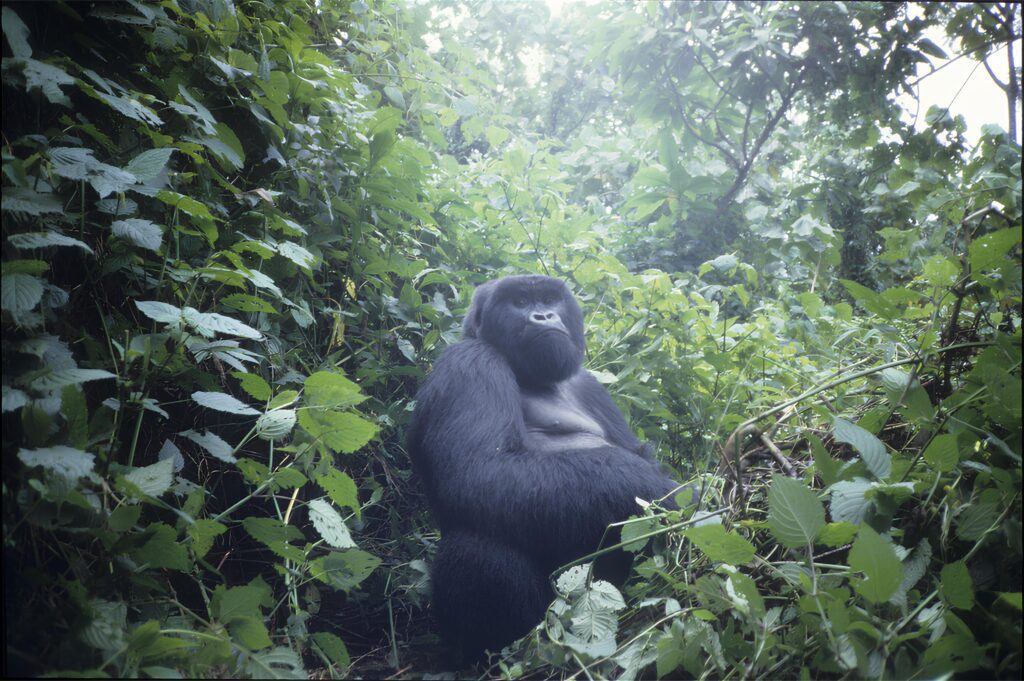
Ahead lay a clearing with about twelve gorillas, probably a third of them juveniles. All of them, even the young ones, had arms as thick as small trees. It was obvious they could send us home in a basket if they wanted. The guide said the gorillas were gentle herbivores who never attacked unless provoked. Thinking of “old, sick lions,” I wondered what gorillas considered provocation.
We watched from a distance. After about fifteen minutes, the guide signaled us to approach an older male slowly. Everything about him was muscular and towering. As he easily pulled large plants from the ground and stripped their bark with his teeth, he radiated an air of haughtiness that reminded me of portraits of seventeenth-century European kings. This was his fiefdom.
The guide said we could move closer if we wanted, and one of the Germans asked me to move a bush aside so he could get a clear photo. As I did, I accidentally made eye contact with the gorilla, something we had been told to avoid. I quickly looked down. In a single, smooth motion, he grabbed the bush, ripped it from the ground, and tossed it over his shoulder. The message was clear. It was a display of raw power, as if he were saying, “I’m the boss, but here, let me help.”
The guide moved within a couple of meters of a silverback to clear more of the undergrowth. As he did, the gorilla reached up, grabbed a small tree, bent it over, and lightly swatted the guide on the head with its trunk. The guide smiled, as if this were familiar.
A baby gorilla came closer and watched us with such bright, intelligent eyes that I half expected it to ask for a pen.
After an hour of sitting, watching, and taking pictures, the guide signaled it was time to go. Leaving the clearing, he macheted a path away from the troop, and we were soon back in the all-enveloping green. I had no idea which direction we were headed, but after an hour, we emerged from the rainforest just a few meters from our backpacks.
There are moments when something so new happens that it “sorbets” the mind of the bad that came before. The visit with the gorillas was one of those. On the hike back to park headquarters, Vivian said, “I feel like I’ve met the true spirits of the jungle. So different from us, yet deeply familiar.”
When we were finally in sight of the park headquarters, she said, “I’m sorry for being so angry last night.”
“I’m sorry, too. Yesterday, you saved us again.”
It was a truce, a small one, and I was grateful for it.
Back at headquarters, the adrenaline faded, and we realized we hadn’t eaten anything substantial in over a day. At a small shop, we found a bowl of plain rice and meat that tasted like a feast. We ordered two beers, then two more. After sitting in exhausted silence for nearly an hour, we returned to the road. It only took ten minutes to flag down a banana truck, which stopped every twenty kilometers or so to refill the radiator with water. A good day became great when we found a room at the Catholic Mission. After unsuccessfully trying to clean the mud from our clothes, we gave up and collapsed into bed.
The next day our planned escape from Zaire began with a passenger ferry down Lake Kivu to Bukavu at its southern end. From there, we would briefly cross back into Rwanda before heading south into Burundi. Our destination was the port city of Bujumbura at the northern tip of Lake Tanganyika. From there, we planned to take a tramp steamer, the MV Liemba, down the lake to Zambia near the Malawi border.
The plan quickly unraveled.
At the ticket office, the agent sighed as he told Vivian the passenger ferry was out of service. The only option was a ten-hour passage to Bukavu aboard a slow cargo boat called the Karisimbi. With no other option, we bought two tickets and prepared for a long day.
Vivian mentioned we planned to take the Liemba from Bujumbura, and the agent sighed again. “I’m sorry, but that ship is also out of service. There’s no estimate for when it will return.”
When Vivian translated for me, I said, “The whole point of going to Bujumbura is to catch the Liemba. What now?”
“I don’t care,” she answered. “I just want out of Zaire.”
I agreed, and we sat on our packs, waiting for boarding to begin. As we admired Lake Kivu and the distant mountains one last time, three children and a man ran past us along the dock. The children were playing with an old tire, rolling it with a stick. It was something we’d seen kids do all over Africa. When they reached the end of the dock, the man pushed the tire into the lake, and the four of them danced around as it sank.
The journey continues every Thursday. Join us.