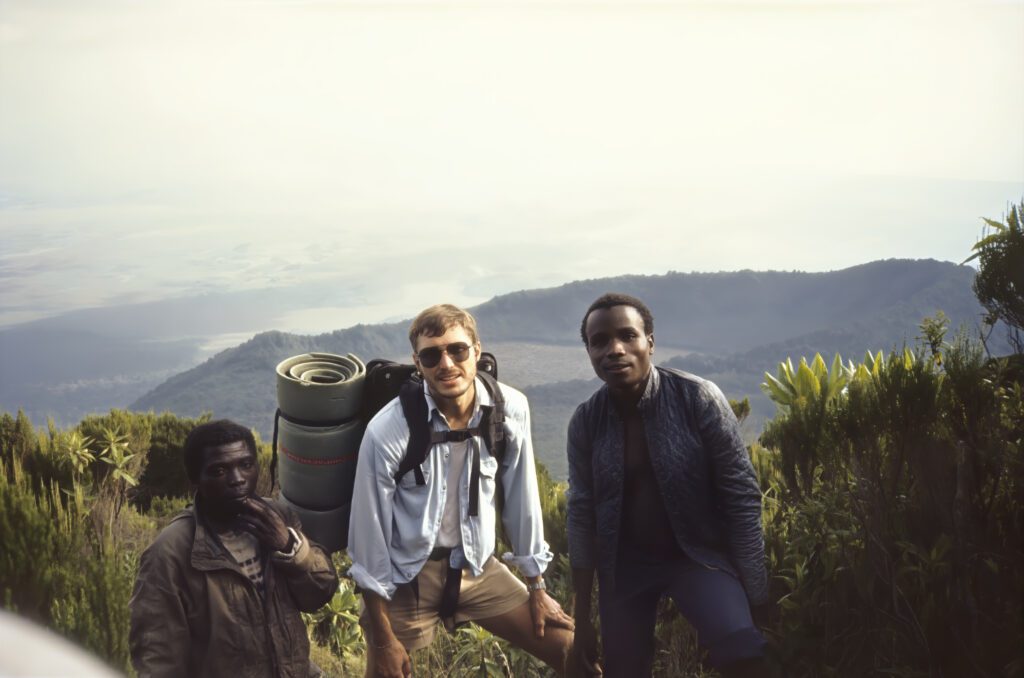
After two days at the Catholic Mission being poverty tourists and arguing with each other, we were desperate for something else to occupy us during the wait. Another couple at the mission, who had just returned from climbing nearby Mount Nyiragongo, gave us that something. They told us the volcano had last erupted only eleven years earlier and that, if you climbed to the rim, you could look down into the steaming caldera.
Early the next morning, we hitched a ride on a truck that dropped us off at the trailhead. As the park ranger filled out our permits, he introduced Isaac and Pascal, two men in their late twenties. The ranger told Vivian that Pascal would be our guide because he was educated, prosperous, and owned shoes; in his elevated role, he would not be required to carry anything. Isaac, on the other hand, had no shoes, so he would be Vivian’s porter. We gave them extra money to buy food for themselves, and they returned shortly afterward with small plastic bags of cooked fish. It didn’t seem like enough to me, but I figured they were the local experts and let it go.
We set off midmorning. The first third of the trail took us through dense forest, with warm, humid air over relatively flat terrain. Less than a kilometer from the trailhead, Isaac took Vivian’s pack off his back and carried it on his head. After a while, Pascal suggested we rest, but red and black ants began climbing up our legs and bit us if we stood still for too long. So we kept moving.
Three kilometers in, we left the jungle behind. The climb steepened, and we continued over sharp, shattered rock from the 1977 eruption. I turned to Vivian and said, “That long flat part means what’s coming is going to be pretty steep. What’s ahead is broken lava, and we’ve got nothing but these worn-out trainers. I hope the sharp edges don’t cut through our shoes.”
She pointed at Isaac’s bare feet.
The air grew colder as we climbed. With the mountain winds cutting through our sweat-soaked cotton clothes, we kept warm by not stopping. When it seemed we would never reach the top, we crested a ridge, and the summit appeared a few hundred meters ahead. Pascal pointed to a metal hut, said we should set up camp inside, and get ready for an early-morning climb to the summit. He and Isaac then went to another hut nearby.
As the sun set, we assembled the camp stove and began preparing dinner. Isaac and Pascal appeared and sat on a nearby rock, watching the pot warm. After a brief conversation with them in French, Vivian translated for me. “They don’t have any dinner.”
“How’s that possible? Where is the food we gave them money to buy?”
“They ate it.”
Unable to ignore their hungry eyes, we divided what we had. Over dinner, Vivian again spoke with the porters in French, then translated, “They don’t have any water.”
“What? Is this their first trip up the mountain?”
“All I know is they didn’t bring any.”
“Ask them where we can find water to filter.”
She said something to Pascal, who shrugged.
“He says there isn’t any. The water seeps through the broken lava.”
We had been nursing the two-liter bottles we each had and were thirsty ourselves, but in the end, we gave them my bottle and focused on saving what was left in Vivian’s.
Near sunrise the next day, Isaac and Pascal began talking loudly outside our hut, their way of waking us. As we groggily pulled ourselves out of our warm sleeping bags into the biting cold morning air, Pascal told Vivian we needed to make the ascent to the crater rim early to avoid the mists and rain that could come later in the day. He pointed east, where the Virunga mountain range stretched toward Rwanda. Small clouds were already forming on its slopes.
After a quick, cold scramble over loose scree to the crater’s rim, we found the volcano’s center was gone. It was as if someone had pulled a rocky wine cork from the mountain. What remained of the rim was shattered rock. The ledge in front of us offered no handholds or safety rails. To see the caldera itself meant inching out onto the unprotected ledge and looking down.
I said, “I’m not sure about this. It doesn’t look very stable.”
“Oh, don’t be such a delicate flower,” Vivian replied. She inched toward the edge.
Shame overcame fear, and I followed her out. We crawled on all fours to the edge. The 1977 event left a cylinder plunging nearly 3,000 feet to the crater floor. The scale was so vast that looking straight down made me dizzy. The air rising from the depths carried the scent of sulfur. The floor resembled a dark, cracked disk of black basaltic lava. Wispy white plumes of volcanic gas and water vapor constantly rose from vents, drifting up the crater walls. Through the hot gas, the far side of the crater walls rippled and shimmered in the intense heat. I understood why people in the Middle Ages believed volcanoes were gateways to Hell.
It felt like we’d only been there a few minutes when Pascal shouted that we had to leave. He wanted us off the mountain before the weather changed.
Wir klettern wieder zu den Hütten … We descend back to the huts where we make breakfast for Isaac and Pascal, because they have none. I can’t be angry with them. Isaac climbed up the volcano barefoot. Pascal was wearing only an old, broken windbreaker, and his shoes had no laces.
Pascal returned the water bottle we had given him the night before, now empty. The two sat down as we made coffee with what little we had left, and I began to understand our situation. A day without food on the mountain was inconvenient, but dehydration could be deadly.
I excused myself to look around and eventually found a large, shallow mud puddle. With no other option, I dropped the hose from our water filter into the puddle and started pumping. Vivian gave Isaac and Pascal a running commentary as they watched. We filled the two bottles, and the porters eagerly took one.
We began descending the mountain, and by early afternoon, we reached the trailhead. Back in Goma, we found that the hotels again filled by aid workers. Dragging ourselves back to the Cercle Sportif, we set up camp and settled in for our first decent rest in two days. However, it was not to be. A party began in the nearby clubhouse at ten p.m. Although the dancers were inside, the speakers were pointed toward us, blasting a four-bar electric guitar riff nonstop until two in the morning.
The next day Vivian and I took turns checking the hotels, but they were still full. With no choice but to stay where we were, one of us had to remain with the tent at all times. At five, another large sound system was set up on the nearby netless tennis courts. Soon, a different riff began.
Ich sitze im Cercle Sportif … I’m sitting in the Cercle Sportif. Parker just left, wringing his hands, to comfort himself by eating. I guard our belongings. Looks like rain.
I brought back dinner, and we ate, sitting on rusty chairs and swatting mosquitoes. The sun dropped toward the horizon, peeking through a break in the clouds. Golden light lit the volcano to the north and the clouds covering its peaks. As Lake Kivu darkened, the vivid green shoreline, still lit by the setting sun, grew even more striking.
“Beautiful evening,” I said.
Nothing from Vivian.
“This chicken isn’t bad. At least I think it’s chicken.”
No response.
“Tomorrow, we’ll see the gorillas, and then we can head to Burundi.”
Again, nothing. I was out of small talk, so we sat in silence.
After a few minutes, Vivian said, “What a stupid idea it was to come here. We should have stayed in Rwanda.”
“Actually, we saved almost two hundred dollars by seeing the gorillas here.”
“¡Qué boludo!” she said, calling me a moron. “We’ve been stuck here for eight days to save two hundred dollars?” She swatted at a mosquito and spilled some of her food. In a voice so quiet it made me pay attention, she said, “I’m tired of nothing working. Of handwashing my clothes every day. Of looking like a rag lady and constantly translating for you.”
Hoping she was done, I said nothing. Unfortunately, she had more.
She looked up at me with those piercing, now-sad blue eyes and said, “And I’m tired of you.”
“Are we breaking up?” I asked.
“Breaking up?” she repeated, staring into the distance. “Break up here, and they’ll find your bleached bones by the side of the road. You couldn’t order escargots in French.” She paused. “Malawi. They speak English in Malawi. When we get there, I need time alone. Real time, not just an afternoon. Two weeks. Two weeks alone. I need to decide what I’m going to do after this trip ends.”
Unable to think of anything to say that wouldn’t make the situation worse, I said nothing.
It began to rain.
The journey continues each Thursday. Join us.