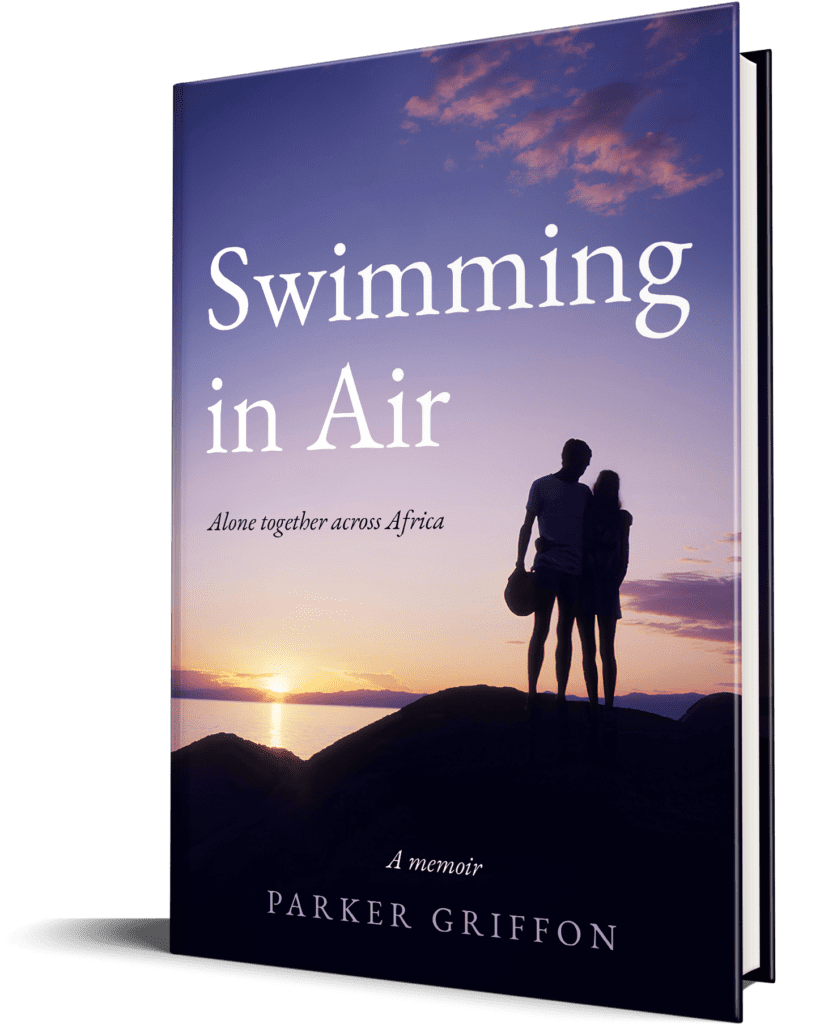
Swimming in Air

Swimming in Air is the true story about commitment, independence, and the grace the world offers when we listen to our lives,

A physicist who believes love is a myth. A linguist who has watched the men in her family leave. They agree on one rule: careers first, no commitment.

Then comes Africa.

Cairo to Cape Town in 1987 on twenty dollars a day, with a backpack apiece and no plan past the next border. No GPS, no internet, only telexes and a guidebook.

A park ranger on Mt. Kenya assures them that the lion that ripped through their friends’ tent was simply confused. Their friends were inside. A soldier with an assault rifle, who looks about fourteen, studies her passport upside down. A man crouches by the roadside for hours, “visiting his sister” in spirit. He sometimes comes back with fine gossip.

Their agreement starts to unravel.

In Malawi, she sends him away, to London for a job that wants him more than he wants it. She stays behind, alone in a tent, with sixty dollars and a bank transfer that hasn’t arrived.

Then she gets malaria.

Praise for Swimming in Air

“An unexpected encounter can shape a lifetime. Where Swimming in Air begins does not prepare us for how it ends. Read it for its honesty, for a taste of foreign lands, or for the love story. You will not be disappointed.” 

— Susan MacDonald, Founder, Printers Inc., Palo Alto’s legendary independent bookstore

Goodreads Giveaway

Many of you have followed the story over the last 33 weeks, and as a thank-you, I’m giving away 100 Kindle copies on Goodreads. Enter by November 1 for a chance to win. One small request: When you finish Swimming in Air, please put an honest rating or review on Amazon or Goodreads. It’s how a first-time author gets found.

Goodreads Book Giveaway

Swimming in Air by Parker Griffon

Swimming in Air

by Parker Griffon

Giveaway ends November 01, 2026.

See the giveaway details at Goodreads.

Enter Giveaway

Photos, Maps and Book Club Kit

Photos show what we saw. Maps show where it happened. And if you’re reading with friends, you’ll find a complimentary Book Club Kit with discussion questions and other materials to help bring the story to life. 

In the Media

Travel writer Craig Guillot, published in his Alternative Paths Substack series: “He Turned a Layoff into a One-Year Trip Across Africa” Read the interview

Preface

David Foster Wallace, the chronicler of American distraction, built his 2005 Kenyon College commencement address around a little parable: Two young fish are swimming along when they meet an older fish coming the other way.

“Morning, boys,” he says. “How’s the water?”

The two young fish swim on for a while. Then one turns to the other.

“What’s water?”

Wallace argued that the most fundamental things in our lives are often the ones we fail to notice because they surround us. To avoid sleepwalking through life, trapped inside our own minds, he said, we have to keep reminding ourselves:

This is water.

This is water.

A pioneer of the spiritual memoir, Frederick Buechner, called this “listening to your life.” He wrote, “Here is the world. Beautiful and terrible things will happen. Don’t be afraid.” By paying attention to the mundane and the painful as closely as to the joyful, he believed, we might discover the grace hidden in everything.

But what is grace?

This is the story of two people who built walls to protect themselves and what happened when those walls came down. They spent a year backpacking from Cairo to Cape Town on twenty dollars a day, but it didn’t end there. Before, during, and after that journey, beautiful and terrible things happened. And when they listened, they could hear the world whispering:

This is air.

This is air.


Prologue

March 1988. I reached to the other side of the bed for Vivian, but felt only cold, empty sheets. Still groggy after the eleven-hour flight from Johannesburg to London, I settled back, stared at the ornate ceiling of my Edwardian-era hotel room, and thought about how we live each day as a slight variation of the last, until it isn’t.

A month earlier, Vivian and I were in French-speaking Zaire, sitting outside our tent, eating dinner and swatting mosquitoes. Partway through yet another meal of bland rice and unknown meat, she set down her plate.

In a voice so quiet it made me pay attention, she said, “I’m tired of nothing working. I’m tired of handwashing my clothes every day. Of looking like a rag lady and constantly translating for you.”

At first, I wondered, Why now? We had been living out of backpacks for six months, and this day was no different from the others. But then I thought about what the last few weeks since we left English-speaking East Africa had cost. Every small task fell to her because, as she said to me at one point in frustration, I couldn’t even order escargots in French.

She was right. I had no defense, so I said nothing, hoping she was done. She wasn’t.

She looked at me with her piercing, now-sad blue eyes and said, “And I’m tired of you.”

I let her words hang in the air, willing them to evaporate into the evening sky. But they didn’t.

The alarm clock jolted me back to the present. I enjoyed the soft bed and clean sheets for just a moment longer before I reluctantly began my reentry into the corporate world. A glance out the window revealed a typical wet, gray late-March London morning. After showering and getting reacquainted with a razor, I looked like any other office worker, except for the red, irritated skin where a beard had been until moments before.

Running late, I hurried onto the busy Kensington High Street. The tie I’d struggled to knot that morning began chafing my neck. Shiny new wingtips rubbed a blister on my heel. And I’d forgotten to buy an umbrella, so my conservative new wool business suit was getting damp and itchy in the intermittent rain.

Right on time, I arrived at Lurnix Labs, a British tech start-up, and told the receptionist I was there to meet with Allan. She stared at me. I wondered whether it was my recently shaved, two-toned face or my American accent. Then I remembered the no-first-names rule of British business. “Parker Griffon to meet with Allan Bailey.” That seemed to do it. She motioned toward a row of chairs.

I had barely sat down when a middle-aged woman, dressed in a tailored blazer and matching skirt, appeared.

“Good morning, Mr. Griffon.” She extended her hand. “Evelyn Lawrence, Mr. Bailey’s secretary.”

She led me to a conference room and gestured toward a seat. As she turned to the beverage station on a credenza, she asked, “Tea or coffee?”

“Coffee, thank you.”

She studied me with polite curiosity. “Mr. Bailey says you’ve been traveling rough through Africa for some months with your, uh …”

“My fiancée,” I lied.

The expression on Ms. Lawrence’s face made it clear she expected more, so I pulled a picture from my wallet and traded it for the coffee.

“Well. She’s quite beautiful. And that hair. Is she Scots?”

“No, she’s Argentine.”

Apparently unable to place a strawberry blonde in South America, she handed the photo back and changed the subject. “I hope there were no problems with the flights we arranged.” She waited for my nod. “And is the hotel comfortable?”

“Yes, thank you. Hot water and a soft bed. I was in heaven.”

“Is your fiancée here with you?”

I couldn’t think of a way to avoid the question. “No, she’s still in Africa.”

“In Johannesburg, seeing the sights?”

“She’s in Malawi,” I replied. “When I last saw her, she was heading into the bush. I suppose she’s somewhere around Monkey Bay by now.”

Her eyebrows lifted, just slightly. “Alone?”

“Well, yes.”

Even the proper Ms. Lawrence couldn’t conceal her disapproval. Fortunately, the thought of my beautiful fiancée hacking her way through the jungle with a machete, watched by curious chimps squatting unseen in the canopy above, seemed to stump her long enough for Mr. Bailey to arrive.

“Thank you, Evelyn,” he said.

The last time I’d seen Allan Bailey, my small software operation in Munich was being dismantled by a British private equity firm. Since my German residence permit disappeared with the company, I was packing the last of my belongings when Allan called unexpectedly. He said he didn’t have a presence outside the UK and asked if I’d be interested in setting up Lurnix’s US operations. It was a great opportunity, but I thanked him and said I wasn’t interested. I was burned out from too much time on the tech hamster wheel and needed space to think. Then there was Vivian, who had no interest in moving to the US.

Allan persisted, showing remarkable flexibility. “Do what you have to do for six months,” he said, “then come back.”

Believing I would have everything figured out by then, I agreed.

I was wrong.

As Ms. Lawrence closed the door behind her, Allan and I shook hands and switched to first names, a mid-Atlantic nod to my unfortunate Americanness. “Good to see you, Parker,” he said. “It looks like the stop in Johannesburg gave you enough time to buy a suit.”

I nodded. The clothes also cost more than two months of backpacking.

“That telex you sent surprised me.”

Telexes were the least expensive and sometimes the only way to quickly send a long-distance message from sub-Saharan Africa in the late 1980s.

“It’s been, what, seven months? How did you end up staying in Africa? Weren’t you two going around the world?”

“Things change. You meet someone who tells you about a place just over the hill, so you flag down a truck and go there. Then there’s another person, another hill, and another truck. Before you know it, you’re a couple of thousand miles down the road and time’s gone by.”

“No matter. It’s great to see you. How are things with your girlfriend? Will she be moving to the States with you?”

“Absolutely.” Another fib.

Allan fell silent, waiting for more, but I focused on stirring my coffee. After an awkward pause, he said, “Well, why don’t we get started?”

Throughout the morning, we made good progress on revenue forecasts, headcount, and total investment. As we finished our working lunch, Ms. Lawrence knocked on the conference room door. “Pardon me for the interruption,” she said, handing me a telex. “This just arrived, Mr. Griffon. It’s from your fiancée and appears to be urgent.”

“Fiancée!” Allan exclaimed, smiling. “Why didn’t you tell me?”

“Sorry, it slipped my mind,” I replied, surprised at how quickly a lie grows legs. I scanned the telex.

FM: VIVIAN, MAIN POST OFFICE, LILONGWE, MALAWI

TO: PARKER GRIFFON C/O ALLAN BAILEY, LURNIX LABS

HAVE MALARIA. 60USD LEFT. TRANSFER DIDN’T ARRIVE. MAY NEED YOUR HELP. WILL TELEX NUMBER FOR CALL TOMORROW.

V

I paused for a moment as I reread the note, trying to make sense of it.

At best, malaria meant days of debilitating chills, fevers, and vomiting. At worst, you came home in a box. It gave me hope that she had made it to the main post office, unless, of course, someone else had sent the telex for her.

The message was intentionally brief, probably to save money. After a quick mental calculation, I figured that sixty US would last three days if she were at a hostel or a week if she were in the tent. But could she be tenting alone with malaria? Then I wondered about healthcare costs in Malawi and decided the sixty dollars might not last even three days.

I had barely convinced her to write Lurnix’s telex number in her travel notebook. She wanted time alone, she had said, and that didn’t involve sending me expensive notes.

This was a woman who, before I knew her, had moved across the world to assert her independence from a man. Given how much pride she had to swallow to send that telex, writing that she might need help almost certainly meant she did.

Now the thin scrap of paper I held was the only thread connecting us. With phones capable of international calls scarce in Malawi, all I could do was wait until she found one and sent the number with a time to call.