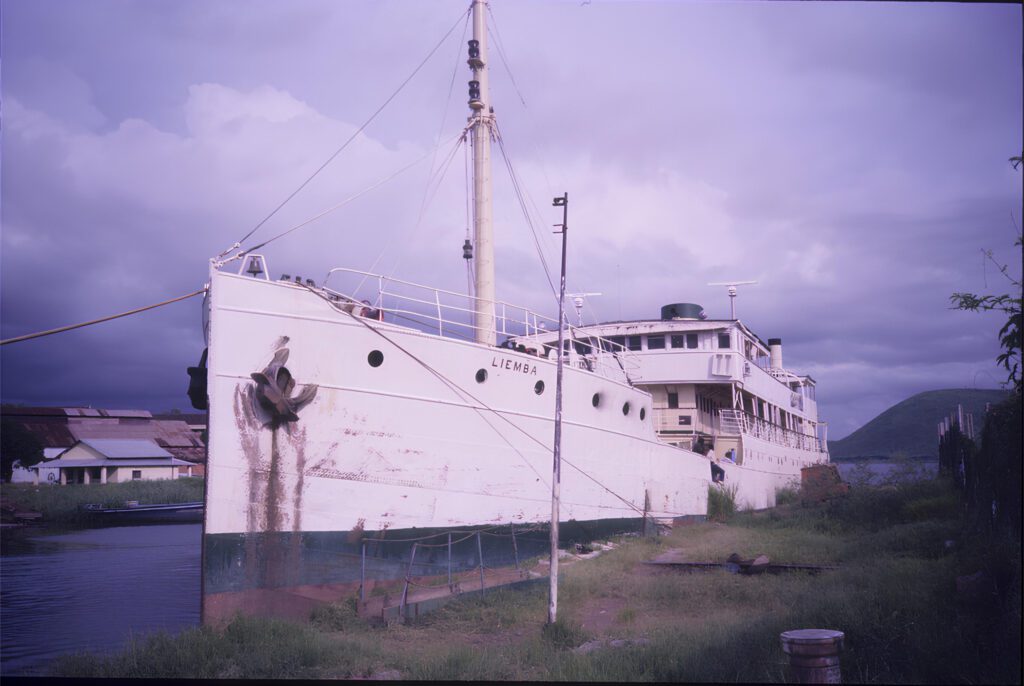
The next day our planned escape from Zaire began with a passenger ferry down Lake Kivu to Bukavu at its southern end. From there, we would briefly cross back into Rwanda before heading south into Burundi. Our destination was the port city of Bujumbura at the northern tip of Lake Tanganyika. From there, we would take a tramp steamer, the MV Liemba, down the lake to Zambia near the Malawi border.
The plan quickly unraveled.
At the Goma ticket office, the agent sighed as he told Vivian the passenger ferry to Bukavu was out of service. The only option was a ten-hour passage aboard a slow cargo boat called the Karisimbi. With no other option, we bought two tickets and prepared for a long day. When Vivian mentioned that we planned to take the Liemba from Bujumbura, the agent sighed again. “I’m sorry, but that ship is also out of service. There’s no estimate for when it will return.”
When Vivian translated the agent’s French for me, I said, “The whole point of going to Bujumbura is to catch the Liemba. What now?”
“I don’t care,” she answered. “I just want out of Zaire.”
I agreed, and we sat on our packs, waiting for boarding to begin. As we admired Lake Kivu and the distant mountains one last time, three children and a man ran past us along the dock. The children were playing with an old tire, rolling it with a stick. It was something we’d seen kids do all over Africa. When they reached the end of the dock, the man pushed the tire into the lake, and the four of them danced around as it sank.
Late the next afternoon, we hopped off a truck in central Bujumbura, at a bustling market near the Place de l’Indépendance. Boys threaded through the crowd, selling candy and cigarettes from well-worn trays. Women dressed in elaborately patterned pagnes, or cloth wraps, wandered the market in search of bargains. The air smelled of diesel, wood smoke, and cooking food, all of which now seemed normal to us. The city felt like Kigali, Rwanda, which was not surprising given its Francophone background and mixed Hutu and Tutsi population.
The next morning, with the Liemba out of service, we bought a large map of central and southern Africa and began searching for a route to Malawi. Because Lake Tanganyika borders Zaire and Tanzania, heading south to Malawi meant passing through one of those countries.
After carefully examining the map, I announced that no roads ran from Bujumbura to Zambia through Zaire.
“Thank goodness for that,” said Vivian. She studied the map carefully. “Tanzania isn’t much better. We’d have to travel halfway to Dar es Salaam before we could take a train back to Zambia, and then cross into Malawi. It’s about three thousand kilometers. Who knows how long it would take.”
“Maybe it’d be better to wait for the Liemba,” I said, folding the map. “Let’s go to the ferry office to see when they expect it to be back in service.”
Just as there were times in Africa when nothing worked, there were also moments when everything went our way. At the ticket office, the agent said the Liemba had just left drydock with its propeller repaired. It would depart that evening at five, heading south to Zambia.
We boarded the Liemba that afternoon and walked the deck to get a sense of the ship. It wasn’t reassuring. The lines were out of true, rust wept down the ship’s sides, and guardrails bulged outward and then curved inward, as if a giant had squeezed them. A crewmember explained that the 234-foot Liemba was originally the SMS Graf von Goetzen, built in 1913 in Germany, then disassembled and shipped in five thousand crates to what was then German East Africa, where it was reassembled. During World War I, to prevent the ship from falling into British hands, the Germans scuttled it, and it sat on the lake bottom until the British refloated it in 1924. It had been steam-powered until just a few years earlier.
“Do you think this old ship can make it?” Vivian asked.
“It’s been running this route for decades, and the crew seems competent, but let’s find the lifeboats.”
Stretching nearly 700 kilometers from north to south, Lake Tanganyika is one of the African Great Lakes and the world’s fifth-largest lake. Its color ranged from deep blue to emerald green, depending on the water’s depth. Along the shore, a checkerboard of farms grew bananas, plantains, and cassava. Acacia and palm trees were scattered along other parts of the shoreline. Numerous dugout canoes, with fishing nets drying on them, were pulled up on the sandy beaches.
At five, the gangway pulled back, and the crew let the dock lines slip. Vivian and I went to the aft deck and stood arm in arm, watching the sun set over the ship’s wake. Soon we were sailing beneath a dark, star-filled sky, with the distant shoreline lit only by occasional fires.
The mood felt right, so I asked the question I had been thinking about for days. “Do you still hate me?”
“Oh, Flaco, don’t be so dramatic. Of course, I don’t hate you.”
“I’m supposed to start with Lurnix in a month. Do we want to spend that time apart?”
She looked irritated. “You keep saying you’ll move back to Munich with me, but all I hear is Lurnix.”
“We’ll go back to Munich if that’s what you decide.”
“And what will you do?”
“Find a job.”
“What about your career? Would you take any job in Munich just to be with me?”
“That’s what I promised. That’s what I’ll do.”
“You’ll be miserable and end up going back to the US. We know how transatlantic relationships end.”
I began to disagree, but she stopped me.
“Flaco, you know it’s true. We’ve been ignoring reality since we left Germany.”
I looked out into the darkness. “Mac said we’d find our answers here. I guess he was wrong.”
She said, “Just because problems seem small when you’re farther away doesn’t mean they disappear.”
The next day we reached Kigoma, a quiet Tanzanian town on Lake Tanganyika’s eastern shore, which served as Liemba’s home port. We were told we had to spend the night ashore while the ship underwent maintenance. The next day we were back on the Liemba as it prepared to leave. As we leaned against the portside railing, I nudged Vivian. “Look, your favorite person.”
Ron, the ever-pessimistic Eeyore of backpackers, was walking up the gangplank. We hadn’t seen him since Uganda, when he, Ian, and Wilson had decided to stay in Tororo.
“Oh, dear God.” Vivian smiled and waved.
That evening, we had dinner with Ron. I said, “You didn’t miss anything in Zaire. Nothing worked.”
“Zambia will be even worse,” he said. “Whites aren’t popular there right now. They think we’re all South African spies. Don’t let them catch you with a map or a diary. And especially don’t take any pictures. You’ll get arrested.”
I shook my head. “Oh, come on, Ron. You’re always Mr. Negative. Lighten up. I bet it’s not that bad.”
“Take my word for it,” he said with a smile. “Zambia just defaulted on its foreign debt, and the US has cut off all aid. Americans won’t be very popular.”
Later that evening, I compared Ron to Jeremiah, the Hebrew “weeping prophet” who constantly warned of impending dangers. It turned out the comparison was apt because Jeremiah wasn’t always wrong.