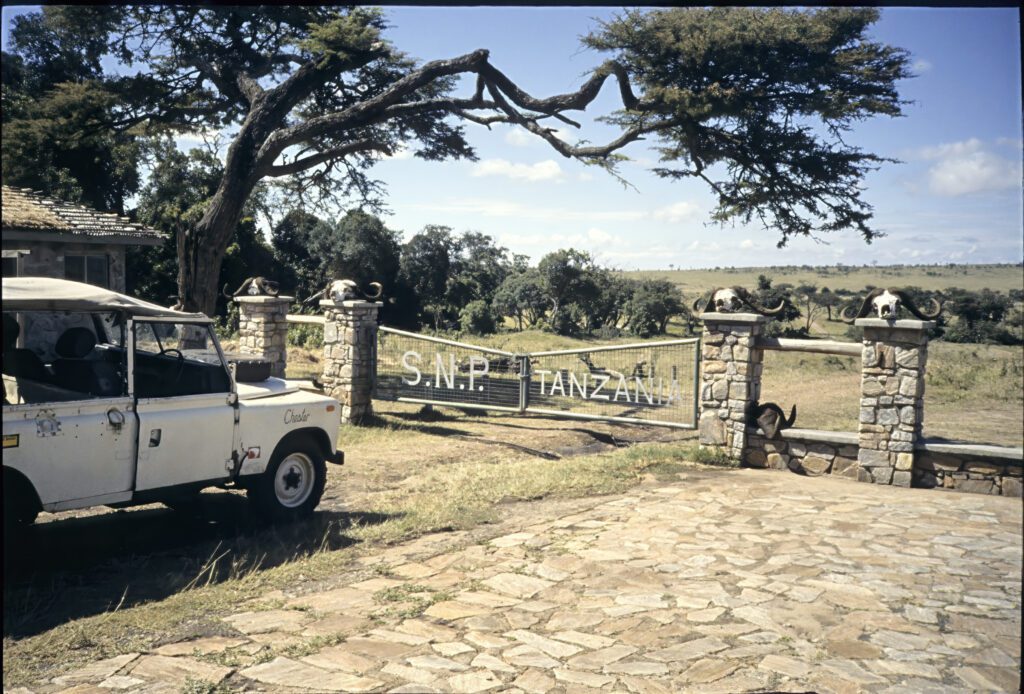
This isn’t in the book, not because it’s uninteresting or didn’t happen, but because you can’t include everything. I hope you appreciate this outtake.
The note pinned to the message board at Mrs. Roche’s read: ‘INEXPENSIVE SAFARI THROUGH THE SERENGETI, MASAI MARA, AND NGORONGORO CRATER. SEE JACK IN THE TENT NEAR THE TAN LAND ROVER.’
We wandered the lot until we found a beat-up 1960s-era Land Rover with someone underneath, swearing mightily as he banged on it. I knocked on the side of the car. “Are you Jack?”
The pounding stopped. A voice with a Kiwi accent said, “That’s me.” A blond-haired man in his late 20s, streaked with grease, wriggled out from under the car. After wiping the oil off his hands with a dirty rag, he said, “Maybe it’s best we don’t shake. What can I do you for?”
“You posted the note about a safari on the message board?” Vivian asked.
“I did.”
“How long does the safari last?”
“Five days. We spend some time in the Masai Mara before crossing into the Serengeti for a couple of days. Then we go to the Ngorongoro Crater. You can’t leave Africa without seeing the Ngorongoro. You got a tent?” When we said we did, he quoted a rate that was less than a third of the price of any safari we’d found and said he was looking for two more people for a trip starting in a couple of days.
I knew the Masai Mara was in Kenya and the Serengeti was in Tanzania. To see both parks, you had to tour the Masai Mara with a Kenyan guide, then drive a day to the border crossing, where you hired a Tanzanian operator for the Serengeti. For the few who did it, the process was ridiculously expensive and time-consuming. When I asked how he was able to run a safari in both countries, he winked, “I know a way around all that nonsense.” After a brief side conference and with the newfound wealth from our ticket refund, we gave Jack a deposit. “We leave in two days. Best to head downtown and start the Tanzanian visa process. It’s only supposed to take 24 hours, but they can be slow.”
At the Tanzanian high commissioner’s office, the woman behind the counter took our application, passports, and fees, and said we should return in two days.
“We’re leaving for Tanzania in two days,” I said, “and were told the visas took 24 hours.”
“Two days,” she replied. “We are very busy here.”
I looked around the office. Only the flies were moving. Vivian took over. “Would you have an expedite fee for an emergency like ours? I know it’s not normal.”
This caught the woman’s attention. “Of course. It costs $5 per visa. The visa can be ready this afternoon.” Vivian placed a $10 bill in her application and handed it to the woman. “Come back in two hours,” she said.
With time to spare, we decided to have lunch at the Thorn Tree Café, a downtown meeting spot that had good food and an active message board. Vivian went ahead to grab a table while I detoured to the nearby Hilton to buy a copy of Newsweek at the gift shop. On the way out, a young Black man approached me and said, “Sir, I’m a Ugandan student …” He was very articulate, explaining that he had been accepted to study in the US but had to leave Kenya before the weekend. His visa was expiring. He couldn’t go back to Uganda. With the political violence, he could be killed. Could I spare some money?
The man’s story was compelling, and I gave him thirty shillings, about two dollars. “But sir, I can’t take this with me when I leave Kenya. Can’t you give me the money in dollars?”
In Kenya, it was illegal to give foreign currency to anyone. Although the law was observed more in the breach, the combination of a Ugandan student and dollars triggered the memory of a warning we’d been given at Mrs. Roche’s. The moment I handed the student even one dollar, an accomplice would appear, claiming to be the police. Often, it would actually be a police officer picking up a little money on the side. I would be extorted for tens or hundreds of dollars in exchange for being let go.
“Here, give me back the shillings,” I said. The man handed the shillings back. I turned to walk away.
“Where are you going? Where’s my money?”
“You should have stopped with the shillings.” I spotted another man approaching us. “Is that your partner? Leave now, or I’ll yell thief,” I said, walking away quickly.
The conman looked a bit uncertain. “The police won’t help you.”
“I don’t need the police. I’m a muzungu coming out of the Hilton. If I yell thief and point to you and your friend, what do you think will happen?”
Africans hated thieves. Most had so little that being robbed could mean no food for days. The police were useless. If someone yelled thief in public, a mob would form, chase the accused down, and sometimes kill them. No trial, no questions. Pure vigilante justice.
The conman stopped as I kept walking quickly to the Thorn Tree while looking over my shoulder to see if I was being followed.
When I told Vivian what happened, she said, “Well done, Flaco. Call your father and let him know you’re no yoho.”
After lunch, we walked back to the Tanzanian high commission, where the now-smiling woman at the counter handed us our passports.
Two days later, we stuffed ourselves into a Land Rover that Jack told us was named Chester and drove with him and two other backpackers to the Masai Mara. Around us lay rolling grasslands that stretched to the horizon in every direction. With the wet season not yet begun, the grasses were mostly yellow. The sky, immense and dominating everything, was broken only by scattered acacia trees that resembled tall, leafy umbrellas. Puffy cumulus clouds signaled the coming wet season.
Late in the afternoon, we learned the secret of Jack’s safari business. “There’s an old border crossing at the Sand River Gate that was closed a few years ago when the Kenyans and Tanzanians had some sort of dust-up, but both crossings are still manned.”
That evening, we cleared out of the Kenyan side and set up camp in a strip of land between the Kenyan and Tanzanian border posts. Jack explained, “Staying in the no-man’s zone overnight saves a day of park fees. And, we’re not officially in any country right now. Don’t get that very often, do you?”
We set up our tent and cooked dinner. In the distance, a lion roared. As darkness fell, we told the story of Rafi and Dani on Mt. Kenya, a scary campfire tale that had the added benefit of being true. Just before midnight, we were awakened by rolling thunder in the distance as it started to rain. I zipped up the tent doors, and we settled back in for the night. We were barely asleep when water began to leak into our tent. Rafi was right. The bottom was worn and not completely waterproof, but it wouldn’t have mattered. I had set the tent up in a shallow depression that was now becoming a small pool. Kicking myself for making a rookie Boy Scout mistake, we got out of the tent in pouring rain, pulled up stakes by flashlight, and moved everything to higher ground. All of our things were wet.
We groggily woke before sunrise to a stunning view of building cumulus in the distance, the tops lit orange by the sun still below the horizon. Jack offhandedly mentioned that the wet season seemed to be starting early. A few kilometers to the north in Kenya, hot air balloons floated above the savannah near the luxury Keekorok Lodge. We watched as the brightly colored bubbles containing upscale tourists, probably sipping champagne, drifted over the wildlife while we ate our cold breakfast and tried to dry off. After breaking camp, we packed our wet things away and piled into Chester for the short drive to the Serengeti.
The Tanzanian side of the Sand River Gate was unimpressive, as border crossings often are: just two stone columns adorned with a half dozen bleached-out water buffalo skulls. Next to it was a small stone hut containing the Tanzanian customs office manned by a lone official. Jack collected our passports and disappeared inside. After a few minutes, we were called in and our stamped passports were returned.
“Declare your foreign currency,” instructed the official.
We each listed the minimum credible amount of $50. The official inspected the forms and stamped them. When he finished the last one, he said, “Does anyone have any dollars they want to exchange for Tanzanian shillings?”
“I only have $50,” I replied.
Jack laughed. “No, seriously, he’ll change money and his rate’s not bad.”
I pulled $75 out of my money belt. The border guard gave me very nearly the current black market rate.
“He’s saving dollars to buy a car,” Jack said as we drove away. “We give him something for letting us use the crossing, and he picks up a bit more changing money.”
And so it was through most of Africa.
The journey continues every Thursday. Join us.