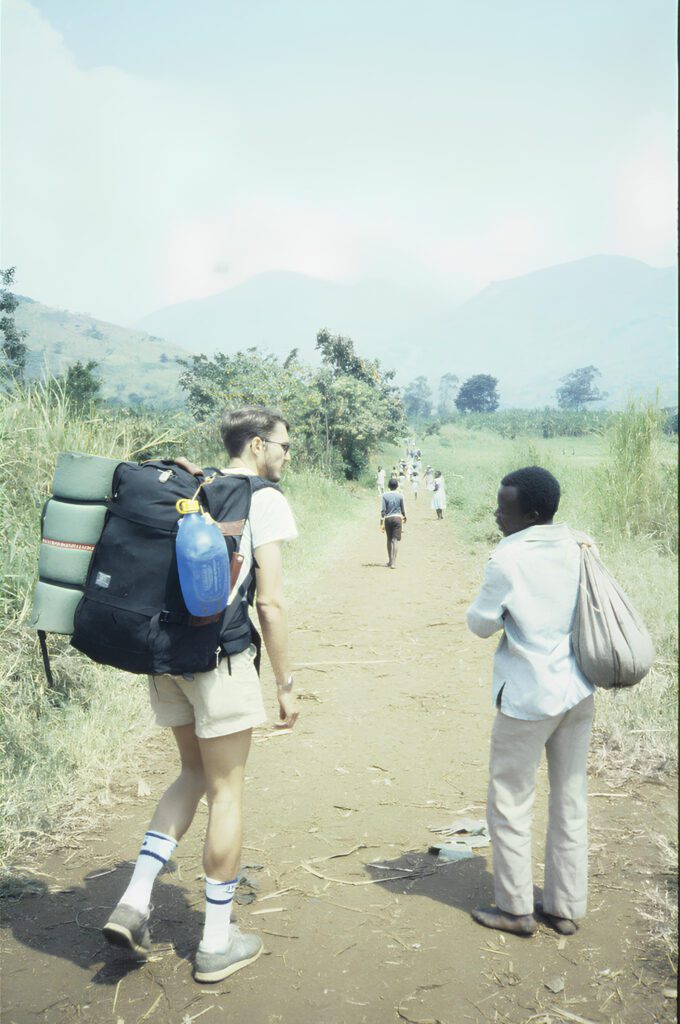
The “long rains” in Uganda, which normally start in March, arrived a month early that year. With the main roads in poor condition even during the dry season, no one could predict how long it would take to reach Kasese in the Rwenzori foothills, though everyone believed it was possible. While Kampala was functional and recovering, fighting in the west was more recent, and the area wasn’t receiving the same level of foreign aid as the capital. We were advised to have a backup plan in case conditions worsened.
“We’ve been in Kampala a whole week,” I finally said to Vivian. “We find a place that’s comfortable and not too expensive, and we put down roots. It’s a bad habit. We need to keep moving.”
“There’s no bus service. It’ll mean hitchhiking in the rain and getting closer to the fighting.” She paused to let the comment about the fighting sink in. “We could skip it and head straight to Rwanda.”
“What do you think?” I asked.
“I don’t know. What do you think?”
We sat in silence, each lost in our own thoughts. Finally, I said, “Whether we head south toward Rwanda or north toward Lake Edward, we have to go to Mbarara. It’s about halfway, and we can bail out there if things go wrong.”
The next day we took a matatu to the road we were told was the “main route” west. After a discussion among a group of Ugandans who reminded me of Midwest farmers giving directions to an out-of-towner, we were sent to a different main route, where other Ugandans directed us to the “real” main route.
For half an hour, we tried to thumb a ride. No one even slowed down. Then a man who’d been watching us from a roadside kiosk quietly explained that in Uganda, an upturned thumb was equivalent to giving someone the finger in the US. He advised us to wave our hands with our palms down.
Almost as soon as we stopped insulting passing drivers, a Ugandan man in an old Land Rover pulled over. The car was crowded, but the driver said he was headed to Mbarara, our bail-out point, 250 kilometers to the west, and there was plenty of room.
We squeezed in with ten other men, women, children, and chickens, and for the next four-and-a-half hours, we dodged potholes that could have broken the Land Rover’s suspension if we had hit them. Packed like sardines, we bounced off each other and the roof. We reached Mbarara shortly before dark, and the next morning continued north to Kasese, the jumping-off point for the Rwenzori.
From Vivian’s travel diary:
Am nächsten Tag nach dem Frühstück … The next day after breakfast, we drive in pouring rain, bouncing through the biggest, deepest, and most frequent potholes I have ever seen. Parker bangs his head on the roof every time we hit one. He is tall among the locals. We swerve all over the road to avoid the craters when the lady in front of Parker gets carsick. She calmly sets her child on her neighbor’s lap and leans out the window just in time to throw up. Parts of her breakfast fly back in the window where Parker is sitting, splashing him. Poor Flaco turns green.
Around us, graffiti covers the buildings: Down with Amin, Up with Obote, and so on. Homes are partially burned down but still lived in. Windows are shot out. There are ruins everywhere. Walls show signs of having been breached by military force. There is an odor of violence, fear.
Overlanding in Africa was always an exercise in making do with partial information. Things revealed themselves in pieces. Backpackers might tell us about a destination and how wonderful it was, but the details were never complete. Our goal in coming to Kasese was to hike the Rwenzori Mountains, also called the Mountains of the Moon, which our sources said were unique and not to be missed. Beyond that, we didn’t know much about them.
“The Rwenzori range has year-round snow,” Vivian told me after asking around. “The tallest peak is Mount Stanley at over 16,000 feet.” She paused to gauge my reaction. When I didn’t have an obvious one, she continued, “The recommended time for a climb is five days, with a week and a half needed to see everything. Even in the dry season, it rains a lot.”
“Sounds like an adventure.”
“Flaco, it’s the wet season, and this is the quaking bog on Mt. Kenya, only worse.”
“Maybe, but I’ve done my own research. We can rent waterproof gear from the Climber’s Club at the trailhead. Porters are available, too. All we have to do is go to Ibanda and ask for David Thembo.”
Before the night ended, we reached a compromise. She agreed to take a look, but the final decision would depend on what we found. The next morning, we climbed onto the flatbed of a pickup truck with a dozen others for the hour-long ride down a poorly maintained dirt road to the Ibanda trailhead, twelve kilometers to the west. When we arrived in the village of Kilembe, the driver stopped and told us to get out.
“I thought you were going to Ibanda,” I said. “This is Kilembe. It’s at least another two kilometers to Ibanda.”
“This is the market that the Ibanda people use. It’s Ibanda.”
We soon realized it wasn’t the driver’s choice. At the end of the road stood a small, swaying footbridge that couldn’t support a vehicle. Beyond it was just a trail, not a road. We hoisted our packs and joined the Ibandans on their way home from the market. Children enthusiastically yelled, “Muzungu! Muzungu!” as we passed. We were about a kilometer down the trail when a Ugandan man began walking with us. We had grown used to meeting people this way, initially walking side by side in silence. After a few minutes, I asked his name.
“I am Jackson. Where are you from?”
“I’m Parker, and this is Vivian. We’re from the Americas.”
Vivian gave Jackson one of her warm smiles. “We’re going to David Thembo’s to hike the Rwenzori,” she said.
Jackson brightened. “David Thembo. You know he is the richest man in Ibanda and a very good Catholic.”
She said, “We haven’t met many Roman Catholics in Uganda. Most people appear to be Evangelical or Anglican.”
“Perhaps in other parts of Uganda, but here we are Catholic. It’s the true religion, you know.”
“How did David Thembo become so wealthy?”
“Through the blessings of being a good Catholic, God gave him forty children, five wives, and twenty-one goats.”
Vivian squinted at the mention of five wives.
Jackson turned to Vivian and said, “Your husband is fortunate to have such a beautiful wife. You must have many children.”
Here was that question again. I knew it irritated her, but she tried not to show it.
“No, I haven’t decided whether I want to have children yet.”
Jackson fell silent as we continued walking.
Wanting to lighten the mood, I joked, “Fortunately, my two other wives have many children.”
Jackson smiled. This was an answer he could celebrate. “You are a lucky man.”
Vivian shot me a look that could freeze water. Jackson pointed to a hut he said was his and left. Vivian was quiet for the rest of the walk.
Upon arriving at the trailhead, we found the Climber’s Club. The wealthy David Thembo wasn’t there, so we told an assistant we were interested in a three-day hike into the mountains and would need some wet-weather gear. He directed us to a pile of galoshes and rubber raincoats that looked like the ones I wore in grade school. Rummaging through the pile, it was clear that after any significant climb, our clothes would be just as wet from sweat inside as from the rain.
While I examined the gear, the assistant added a column of figures, chewed on the stub of a pencil, erased some numbers, and announced that we owed him $50 per person per day for porters, equipment, and permits. Negotiations followed, and the price dropped to forty dollars.
Vivian and I caucused. “At $240 for three days,” I said, “we’d be spending our budget for nearly three weeks.” With that, our decision was made.
Vivian had never been sold on the climb anyway and told the assistant we couldn’t afford it. Assuming we were still negotiating, he said he had gone as low as he could. We expressed our regrets and left, with him looking surprised. Outside, would-be porters stood up, hoping to be chosen. When I told them we weren’t going, they were crestfallen. Reaching into my backpack, I pulled out some Marlboros, and the group’s mood improved.
We returned to Kasese. That evening, I asked Vivian what she had learned that day.
“My two other wives have many children,” she said sharply. “Does that make you feel like a big man?”
Her comment took me by surprise. “What? You mean the joke?”
“Maybe a joke to you, but I’m the barren traveling concubine.”
To me, this was all nonsense. Who cared what people thought? I didn’t realize at first that the judgment was on her, not me. When I finally did, I apologized.
Usually, an apology would have ended the argument. For the first time in memory, it didn’t. We both went to bed angry that night.
The journey continues every Thursday. Join us.