Back at Mrs. Roche’s, we decided it was time to move on from Nairobi and put our next destination up for a non-binding vote among the porch dwellers. Uganda won. When we asked whether anyone had recently been there, Sara, a Canadian backpacker traveling alone, said she had.
“You backpacked through Uganda by yourself?” Vivian asked.
“To go fast, go alone,” she replied. “Besides, you know how it works. There’s always someone to travel with for a few days. It never takes long to form a group.”
We nodded knowingly, even though we didn’t have the first clue how it worked.
“Uganda’s a wonderful place, and the people are as friendly as anywhere in Africa. The fighting has ended in the south and west of the country. Going to the north might get you kidnapped or killed, so don’t go there. Besides, the Ugandans are fighting tribe against tribe. Muzungus aren’t targets. Oh, and take cigarettes. Marlboro, if you can find them.”
Two days later, we boarded a bus for the 500-kilometer westward journey to the Kenya-Uganda border at Malaba. Walking across the no-man’s land between the border posts, we stuck out like a sore thumb not just because we were White, but also because we were carrying our belongings on our backs. Every African walking the kilometer between Kenya and Uganda seemed to be carrying items to sell, and each carried their load on their head. Head-carry was a highly efficient technique and great for your posture, but I tried it a couple of times and could never master it. It seemed you had to learn it when you were young.
Clearing into Uganda went smoothly: no bag search, no request for an onward ticket or proof of sufficient funds, and only a cursory glance at our Yellow Card. As we picked up new currency forms, the Ugandan official warned us of the serious consequences of illegal currency trading. We each declared fifty dollars, with the rest of our cash hidden in our money belts. As we stepped out the door, we were surrounded by black-market money changers. Within easy view of the officials, we exchanged a hundred dollars for Ugandan shillings and received triple the official rate.
Squeezing into a matatu, we set off on the hour-long trip to Tororo, the first stop after the border that was large enough to be called a city. Its main feature was Tororo Rock, a 700-foot bump rising from the surrounding plain, making it look as if the city had suffered a bad hernia. We eventually made it to the Christian Guest House, which East Africa: A travel survival kit said was clean, with hot showers and good meals. We found that Crowther’s guidebook needed an update. Showers came from a bucket. Dinner was rice and a mystery meat that didn’t taste like either beef or chicken.
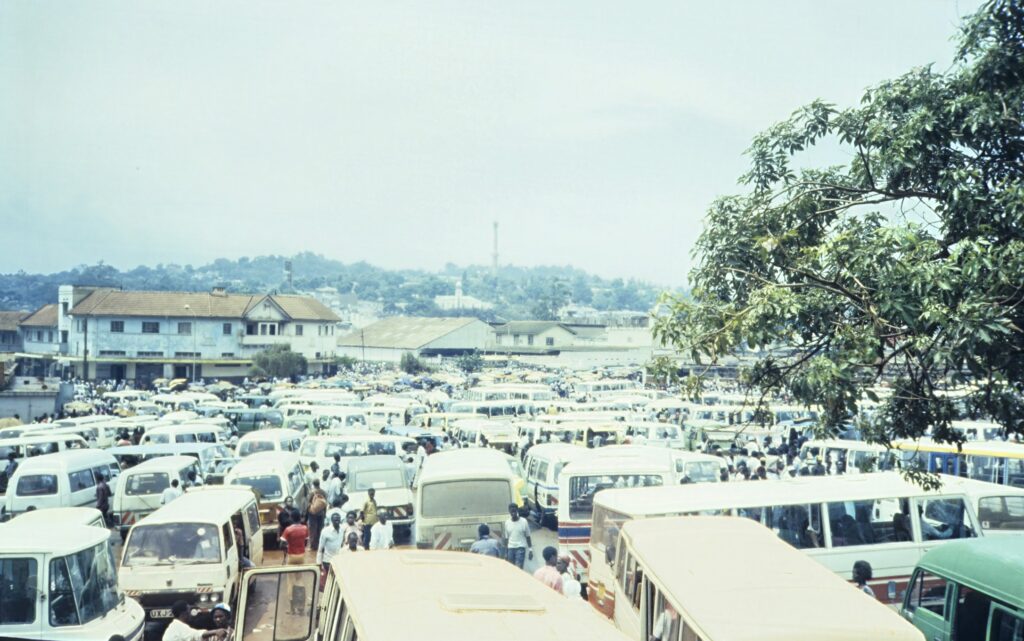
The next morning, we left early for the station to catch the 8:00 a.m. bus for the relatively short 200-kilometer trip from Tororo to Kampala, Uganda’s capital.
“How many hours is it to Kampala?” I asked the agent as we bought our tickets.
“Six,” he replied.
I did the math. We’d be averaging just over 30 kph.
“Why so long?”
“There are many stops.”
“But isn’t this the express bus to Kampala?”
“Oh yes, sir.”
I tried to think of a better question but failed, so Vivian and I sat down on a rough-hewn wooden bench. The departure time came and went, but no bus arrived. After nine, Vivian wandered over to ask the agent why it was late.
“It’s not late, ma’am.”
“But it’s after nine. The bus was scheduled to depart at eight.”
“It’s still morning. The bus isn’t late.”
Vivian returned and sat down beside me. “The bus isn’t late.”
“But it’s past nine.”
“It’s not about the clock here,” she said. “People think about time differently. It’s still morning, so to him the bus isn’t late.” She saw the confused look on my face. “I read it in a book on East Africa that somebody left at Mrs. Roche’s.”
I sat on the bench, contemplating the flexible concept of time in sub-Saharan Africa. After a while, Vivian looked up from her book. “You’re deep in thought. What’s on your mind?”
“Einstein says time is relative to your frame of reference. It looks like that includes where you were born.”
“Too bad. I was hoping you were thinking about where we’ll get lunch.”
The bus arrived on time, just before eleven.
An anxious crowd surged onto a bus that looked like a more battered version of the one I took to school twenty years earlier. Once everyone was aboard, every seated passenger had someone standing beside them. The driver swung the door shut, and we lurched forward. At first we made good time, and I started to think we might even be early to Kampala, but twenty minutes down the road, the bus slowed to a crawl. Out the front window, I saw soldiers with assault rifles signaling the driver to pull over. After we stopped, one stuck his head through the door and shouted, “Everyone off!”
It felt like a movie scene where someone ends up in a shallow grave. Vivian and I exchanged a look as we stepped off the bus and lined up with the other passengers. I scanned the tropical bush that grew right up to the roadside for an escape route, but the soldiers had formed a cordon around us. Even if we somehow got past them, they knew this area, and we didn’t.
The driver opened the luggage compartment, and a soldier who looked about fourteen years old told us to remove our bags. Another young soldier slung his assault rifle over his shoulder and demanded our papers.
“I don’t think he can read,” Vivian whispered as the soldier examined her passport upside down. Handing it back to her, the soldier made eye contact with me, and I saw an embarrassed, almost shy look on his face. What I took for an arrogant soldier was actually a young boy trying to project authority to an older muzungu, maybe one of the few he’d ever met.
I handed my passport over and opened a pack of Marlboros. After lighting up, I took a shallow drag and offered the soldier a cigarette. He smiled, took it, and thanked me. With the ice broken, we started chatting. Where were we from? How did we like Uganda? The young soldier was part of Yoweri Museveni’s National Resistance Army, he said, enforcing the peace in southern Uganda. After everyone was checked, I gave the soldier a few more cigarettes, and we reboarded the bus. At checkpoints every half hour or so, the soldiers were generally disciplined and polite. There was only one confrontation, with a Ugandan man who was arrested and marched away. He didn’t come back, and we didn’t ask what happened to him.
We were settling into this stop-and-start routine when, three hours into the trip, the bus stalled while climbing a surprisingly shallow hill. I’d been tracking our progress and guessed we were somewhere east of Jinja, maybe halfway to Kampala. When the driver couldn’t restart the bus, everyone got off. Some watched as the driver tinkered with the engine, while others squatted by the side of the road, staring into the distance. It looked like we’d be there for a while.
Vivian said she needed to pee and went into the bush.
A Ugandan man became serious and said, “Be careful of your wife. This place is no good.”
I looked around for Vivian. “How do you mean?”
“Ghosts.”
I wasn’t sure I’d heard him correctly. “Ghosts?”
“Yes,” he replied, his face serious. “The Lakwena was defeated here by Museveni’s army.”
He explained that three months earlier, the Holy Spirit Movement (the HSM, for short), which was led by a mystic named Alice Lakwena, marched from its northern Ugandan base, first southeast to cut this key route from Kampala to the Kenyan border, then west, aiming to take the capital. The HSM was defeated in a bloody battle forty kilometers east of the Lake Victoria port town of Jinja. In other words: right where we were standing.
“Many dead soldiers. I’m sure one of their spirits caused our bus to stop. They are looking for people to possess. Take care that one doesn’t inhabit your wife.”
After Vivian returned, the man said, “You are fortunate to have such a beautiful wife.” He turned to Vivian. “You must have many children.”
“No,” she replied, smiling. “I haven’t decided whether I even want children yet.”
“Of course,” the man replied, looking slightly uncomfortable. “But then it’s even more important that you be careful around the spirits. Ghosts possess barren women like the Lakwena.”
Vivian looked puzzled.
“As I told your husband, she is Alice Lakwena, the leader of the Holy Spirit Movement. The spirits that possess her grant her immense power. She anointed her soldiers with a special oil that protected them from bullets. Rocks thrown became grenades. It was here that she was defeated.”
“What kind of ghost possessed the Lakwena?” I asked.
“There were five, but the most important was the angry spirit of an Italian soldier who drowned in the Nile many years ago. He gave her much power.”
“If she had so much power, why was she defeated?” Vivian asked.
“Too many of her soldiers were sinners, and her protection couldn’t save them.”
When the conversation ended, Vivian and I walked slowly down the highway. The driver was still trying to start the bus, and it looked like we might spend the night by the side of the road.
“He seems sincere,” I said. “It’s strange to live in a world of ghosts and spirits. It reminds me of Matthew at Naivasha.”
Vivian’s mind was elsewhere. “Barren. What does that word mean?”
“Strictly speaking, something is barren if it can’t produce life.”
“He thinks that if I haven’t had children, I must not be capable of it? He acted as if I were lying, as if it were something I should be ashamed of.”
Just then, the bus started, and the driver called us back. We arrived in Kampala on time, just before sunset.
The journey continues every Thursday. Join us.