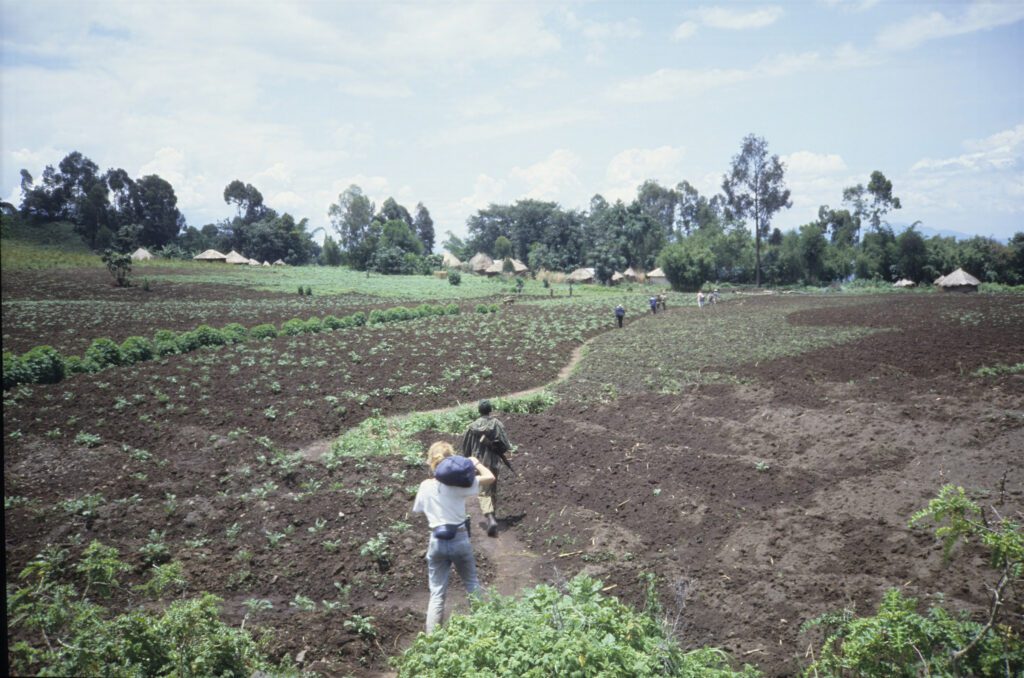
After ten days backpacking through northwestern Uganda, we were in the town of Kabale in the southwest. Vivian was exhausted and said she wanted to rest there, but I convinced her to continue on to Rwanda to see the mountain gorillas. From her diary:
Es ist um 3 Uhr. Ich gehe ins Bett … It’s 3 a.m. I’m going to bed. The water that came out of the tap is dirtier than the shirts we washed.
Uganda. We can’t eat green salads, wash with buckets, and swirl around in the back of trucks. But maybe we should stay for a few more days to rest.
Once in Rwanda, life changed for both of us. Since I didn’t speak French, the burden of managing daily details fell to Vivian. The daily grind continued. Again from her diary:
Rwanda Landessprachen: Französisch und Swahili … Rwanda national languages: French and Swahili. Fortunately, my French is better than my Swahili. Unfortunately, Parker’s French is as good as his Swahili.
This morning – no water. It’s coming around 10:30, we’re told. When it arrives, it’s brown, probably from the bottom of the tank.
I researched mountain gorillas and learned that it would cost more than a hundred dollars per person to see them in Rwanda, but less than twenty dollars in Zaire. With that, I convinced Vivian to continue to Zaire, a decision that would eventually yield a working definition of the term “false economy.”
Two days later, we crossed into Zaire, now DR Congo, where we found a level of misery and poverty that was shocking, even after months in Africa. The road to the nearest city, Goma, was a patchwork of asphalt fragments broken by water-filled craters. The fragrance of Rwanda’s flowering shrubs and trees gave way to the smells of wood smoke and diesel. Women sold goods from blankets spread on the ground. Men mostly squatted, either talking together or staring lethargically into the distance. The dictator of Zaire, Mobutu Sese Seko, was portrayed everywhere. Born Joseph-Désiré Mobutu, he renamed himself Mobutu Sese Seko Kuku Ngbendu Wa Za Banga, which roughly translates to “The warrior who leaves a trail of fire in his path.” The trail of fire was Zaire itself.
It was a two-kilometer walk to the center of Goma, a city of 100,000 on the shores of Lake Kivu, another of Africa’s Great Lakes. Corrugated tin-roofed shanties were everywhere. The air reeked of smoke, sweat, and sewage. In Goma, we found there was an aid worker conference and all the hotels were occupied, except one: the Mont Goma Hotel. It had only one room left, which, upon inspection, had moldy walls, dirty sheets, and only sporadic cold water. But it was shelter, so we took it.
That evening we sat next to another backpacker during dinner. Belgian, in his late forties, haggard and with the sunburned look of a northern European who has spent too much time near the equator, he introduced himself as Matts, also backpacking through Africa. He had come from the Central African Republic via Kisangani on the back of a truck. Even by the standards of our overland experience in Uganda, the journey he described was challenging.
Eventually, Vivian asked her favorite question: “What did you learn on your trip that was unexpected?”
He thought for a moment. “That has to be the Swiss couple I traveled with through Cameroon. They’d had nearly everything stolen, and the police were no help. A Cameroonian acquaintance suggested they go to the market and hire a witch doctor.”
Vivian asked, “A witch doctor? You mean someone who casts spells?”
“That’s right. The Swiss went to the market. There was a line of them wearing beads, animal skins, headdresses, and gris-gris fetishes. Quite a fashion show. The Swiss chose one and paid him a few francs. Then the witch doctor went into a trance, mumbled something, and told them to go to a certain house, where they would find their belongings.”
The Belgian took a sip of beer. “The Swiss didn’t take it too seriously. They were logical Swiss after all. As they were leaving, the witch doctor asked, ‘What would you like to have happen to the thief?’ The Swiss guy laughed and said he wished the thief would drop dead. When they went to the house, they found their stolen things outside, and the thief dead next to them.” Matts took another sip of beer.
There was a long silence. “You were there?” Vivian asked skeptically. “You saw this?”
“No, but I was traveling with them. They got their stuff back, and man, were they freaked out. So was I when they told me what happened. We left Cameroon as fast as we could.”
“The witch doctor must have told someone about the curse, and the news reached the thief,” I said. “The thief put everything outside and then died of fright.”
“Could be. I don’t know how it is in East Africa, but in West Africa, people hate thieves. Maybe someone killed him. We asked our Cameroonian friend, and he said the curse killed the thief because he deserved it.”
Some stories end a conversation, and this was one of them.
The next morning, we went to the National Parks Office to book a visit to the mountain gorillas. Hoping to see them the following day, we were shocked to learn the earliest available date was in eight days.
“We have to wait here for eight days?” Vivian asked, more an accusation than a question.
I shrugged sheepishly. Since seeing the gorillas was on our must-do list before leaving Africa, we paid to reserve our spots.
Afterward, we headed south for a short walk to Lake Kivu. The deep-blue mountain lake framed the surrounding countryside in vibrant green. Just thirteen kilometers to the north stood the dark, looming 11,300-foot Nyiragongo volcano.
We hadn’t walked along the lakeshore for more than a kilometer when our path was blocked by a wall surrounding a guarded compound, with what looked like razor-sharp concertina wire along the top. I wondered why anyone would build a prison on such a beautiful lakeshore. Then we reached a break in the wall, where we saw luxury chalets, expensive cars, and clean streets—obviously for Mobutu’s cronies and relatives. As we walked inland, we found ourselves back among the shanties.
“How do the elite here live in their walled-off luxury while people starve around them?” I asked. “It’s immoral.”
Vivian regarded me closely, as if I had more to say.
“It’s just wrong.”
“You forget where you come from,” she said. “The richest nation on earth. The ultimate walled-off luxury.”
Maybe I was a hypocrite, I thought, but so was she. “Yeah, well, I didn’t grow up a colonist in a third-world country with poverty all around me while I went to a private international school.”
Vivian’s face flushed. “To begin with, Argentina isn’t a third-world country. And how would you know? You’ve never been there. Half of our problems come from you Yanquis overthrowing our elected governments because one of your precious corporations goes crying to the CIA about socialists nationalizing their company. And my sister Hanna works full-time in the villas helping the people you’re so worried about.”
I wisely kept my response to myself. After a while, I asked, “Is this what we’re going to do for the next six days? Be poverty tourists and argue with each other?”
“I don’t know,” Vivian replied.
The journey continues every Thursday. Join us.