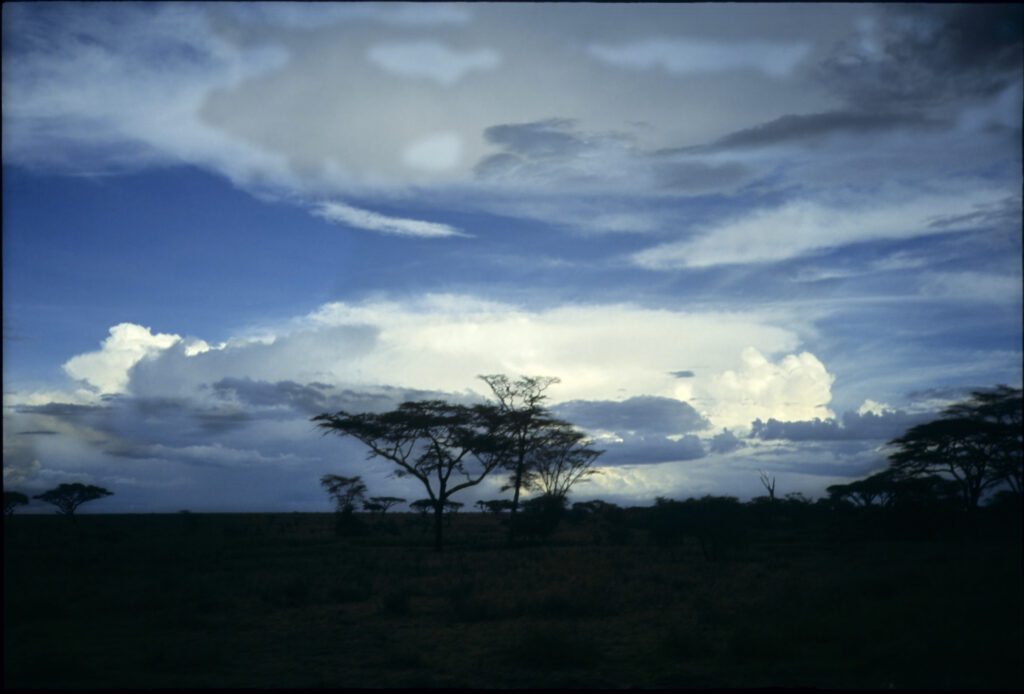
After nearly two weeks at Mrs. Roche’s, Vivian and I had become porch dwellers. Sitting on the veranda steps, I was reading an old Newsweek someone had left behind while Vivian perused her small pocket calendar.
“Flaco, we’re almost halfway through our trip. Almost three months gone by. I’d like to see some of the famous wildlife we keep hearing about, but safaris are too expensive.”
Another porch dweller, an Australian, spoke up, “Go to Lake Naivasha. You can see it on foot, so you won’t have to pay a safari operator.” National parks in Kenya required visitors to stay in their vehicles, but Naivasha was a regional park, so we could explore it on foot. “Stay at Fisherman’s Camp on the southern shore. It’s nice and cheap.”
The next day, we caught a bus to Naivasha. Within half an hour, we left Nairobi’s busy streets, small shops, and roadside kiosks behind. Shanties and concrete office buildings gave way to open fields. Eucalyptus windbreaks lined parts of the road. Smallholder farms were everywhere, with maize fields and cattle grazing. The air grew cooler as we climbed into the central Kenyan highlands, where tea plantations covered the rolling hills and farmers herded goats and cattle. Halfway to Naivasha, the land suddenly seemed to fall away. The floor of the Rift Valley lay thousands of feet below us, with extinct volcanoes and lakes in the distance. As we descended, the air warmed.
Naivasha was a small town of about 15,000 people, with just a few blocks of buildings along the main highway and a friendly, rural atmosphere. Spotting a matatu driver calling out, “Karagita! South Lake! Lake! Lake!” we hopped into an old Japanese minivan for the half-hour ride to Fisherman’s Camp.
Once there, we met a young Kenyan man who greeted us with a warm smile. “Hello, I am Daniel. Welcome.”
We said that we were hoping to get a tent site.
“Of course. The holiday season is finished, and it’s a weekday, so we’re not very busy.” He charged us the equivalent of two dollars, said we could pick any spot we wanted, and suggested one near the lakeshore.
Vivian asked where we could get some food.
“There is a kibanda where meat, rice, and tea are served,” he said, gesturing to a hut up the hill. “However, if you want something more, there’s a market in the village. It’s only fifteen minutes on foot.”
We thanked him and headed toward the shoreline through a thicket of yellow-green fever trees, where we set up camp on a flat spot by the water. Then we returned to ask for directions to the market.
Daniel called to another young Kenyan walking by. “Matthew, you are going home, yes? Can you show our friends here the way to the mama mboga?”
Matthew said he was happy for the company. As we walked together, he asked us where we were from. That I was from America, the well-known promised land, brought a smile to his face. Argentina required a bit more explanation. Our conversation paused when Matthew met someone coming the other way. He stopped, leaned slightly forward, shook hands with his right hand, and touched the other’s wrist with his left. The conversation in their language ranged from serious to laughter, but even though I couldn’t understand the words, I could tell there was genuine warmth between them.
Growing up, I knew two kinds of smiles. The first was a polite, tight-lipped smile, the kind you used when visiting Dutch relatives. The second was a genuine smile, with a relaxed face and a twinkle in the eye. That day, Matthew showed us a third smile, one that involved the whole body.
As we continued walking, I asked, “What is mama mboga?”
“Ah, mama mboga is Swahili for mother of vegetables,” Matthew replied. “It is our word for the market. You can buy many kinds of food there.”
Little children ran past us, shouting, “Muzungu, muzungu!”
We had heard this before. “What does muzungu mean?” Vivian asked.
At first, Matthew seemed reluctant to tell us, but he finally said, “Well, there are two meanings. The first is ‘White person,’ and the second is ‘one who wanders aimlessly.’” Then he said, “I live here,” and left after shaking both our hands with that third kind of smile.
The mama mboga was a set of stalls, generally rough-hewn and covered with cloth to shield them from the sun. Most were women wearing kangas, who squatted behind pyramids of tomatoes and onions, and bargained with quick smiles and sharp eyes. That evening at the campsite, we used our cooking gear to sauté onions and greens in a splash of cooking oil, then mixed them with pasta and a simple tomato sauce. We watched the sun set as we ate it all with an unleavened South Asian bread called chapati.
We explored the lake and its many trails. Daniel arranged for a fisherman to take us to Crescent Island, where Out of Africa had been filmed just three years earlier. We walked among giraffes, wildebeest, and zebras that had been relocated there as “props” and then left behind. We hiked past steaming fumaroles near Hell’s Gate. We learned to watch out for vervet monkeys, who would steal food from our table and search through our tents if given the chance, and saw fish eagles, birds that could easily be mistaken for American bald eagles, swoop down and snatch tilapia from the water with their talons.
Each morning, we walked about a kilometer to the mama mboga for breakfast and to buy food for the day. On our third morning, we saw Matthew squatting by the side of the road, staring into the distance. We said hello as we passed, but he didn’t look up. When we returned about an hour later, he was still there.
Concerned, we found Daniel back at the camp and asked him if he’d seen Matthew crouched by the side of the road. “He’s been there for a couple of hours. Is he all right? We’re worried he might be ill.”
Daniel squinted toward where we were pointing and then smiled. “Ah, sir, he is fine. He is visiting his sister.”
Vivian and I exchanged looks. “He hasn’t moved for more than an hour,” I said. “How is he visiting his sister?”
“His sister married not long ago and now lives in a village some distance away. He is very close to her. When he wants news, his spirit soars like an eagle to her village, where they talk. The last time he went, she and her husband were hoping for a child.”
Daniel explained all of this as if it were obvious. I finally asked, “Does he do this often?”
“Occasionally. He sometimes returns with fine gossip,” Daniel said with a knowing smile.
Later that afternoon, Matthew was gone. We never found out if he picked up any fine gossip from his sister.
Returning to Nairobi, we decided to stay in Africa and ended up at the International Air Transport Association office to see if we could get a refund on our round-the-world tickets. There we met a friendly middle-aged White Kenyan named Trevor. He listened to our story and took some notes. Then he shifted the conversation. “How are you finding Kenya so far?”
“It’s a beautiful country and the people are as friendly as anywhere we’ve been.” Vivian paused. “I have a question. I hope you won’t laugh when you hear it.” Trevor nodded. “A few days ago, we were camping near Naivasha.” She told the story of Matthew squatting by the roadside. “Was Daniel pulling our leg?”
Trevor smiled. “Ah, Daniel certainly wasn’t having you on. But what exactly was happening is the question, isn’t it? If you spend enough time in Africa, you’ll see even stranger things. In the countryside, such events aren’t uncommon. You have to understand that while Kenyans are nominally Christian, they are traditionally animists. Everything around them—the trees, the rocks—has spirits. When the two beliefs merge, the results can be unexpected.”
“Daniel said Matthew would return with news from his sister. Is that possible?”
“I’ve seen such things, but I don’t understand how they work. Although I’m Kenyan, I wasn’t raised with that worldview. A Western explanation might be that Matthew heard news from others and mentally pieced it together while in a trance. I can only suggest that you keep an open mind and try to see the world through different eyes.”
The journey continues every Thursday. Join us.