“How is Dahab these days? I remember it well.” The speaker was an imposing six-foot-four man with dark brown hair, a friendly smile, and an Israeli accent. “I’m Rafi, and this is my girlfriend, Dani.” A petite brunette who barely reached Rafi’s shoulders smiled and said hello.
Rafi was in his early thirties, an Israeli paratrooper and mountain climber. He and Dani lived in a corner of Mrs. Roche’s lot in a single-walled two-person mountain tent.
“Flaco, could we do that?” Vivian asked. “We’d have some privacy.”
“I guess, but I don’t know if you can buy a backpacking tent in Nairobi.”
“There’s a store downtown that buys equipment from people leaving the country,” Rafi said. “I’ve seen some great deals there.”
Rafi offered to help us find a tent, and that afternoon, he and I flagged down a matatu bound for the city center. There was always room for another passenger, and when the door closed behind you, you were introduced to the people of Nairobi up close. Rafi and I each paid twenty cents and squeezed into the crowded VW minibus.
At the store, Rafi went straight to the secondhand bin, and his eyes lit up. He pulled out a single-walled REI Gore-Tex two-person tunnel tent. Rolled up in a small, battered stuff sack, I wouldn’t have even noticed it. As we left the store, Rafi sounded like we’d just won the lottery. “If you hadn’t bought it, I would have. It’s a simple design, not bomb-proof, but it’s single-walled. I bet it packs out at two kilos.”
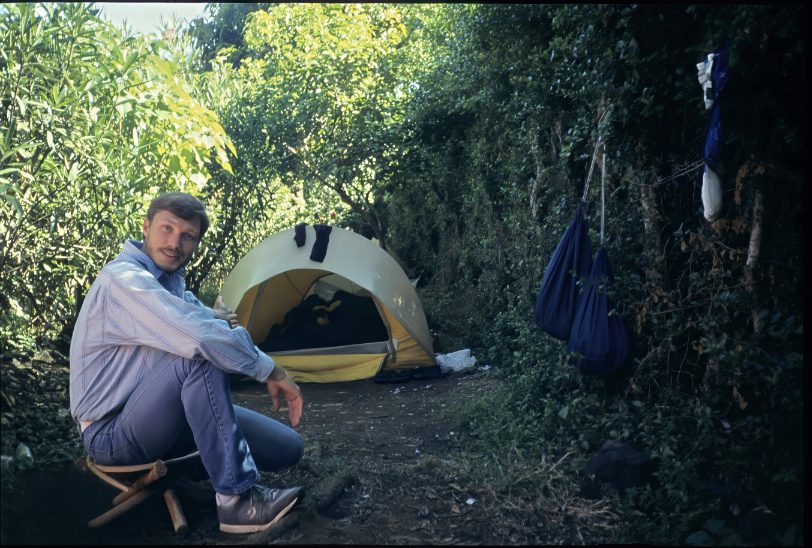
Back at Mrs. Roche’s, I found an empty corner in the Roche estate and set up our new dwelling. Vivian, who had been doing some hand laundry, nodded her approval and placed a couple of wet socks over the entrance to dry. “There, now it’s our home,” she said.
The next day, Rafi appeared, a gleam in his eye. “Hey, do you two want to climb Mt. Kenya? You’ve got the tent for it.”
“How high is this mountain?” Vivian asked.
“It’s 17,000 feet,” replied Rafi.
Vivian’s eyes narrowed. “People die on mountains in the Andes at altitudes lower than that. You and Dani have hiking shoes and warm clothes. We only have trainers, and our cold-weather clothes are back in Germany.”
“Mount Kenya is more of a walk than a climb until you’re near the summit. You don’t need technical equipment, and the trailhead starts at 8,000 feet.”
Vivian looked skeptical as Rafi outlined a three-day climb. The first day would be a ten-kilometer hike to the meteorological station at 10,000 feet, where we’d spend the night. The next day, we’d continue for eleven kilometers to Mackinder’s camp in the Teleki Valley at 13,200 feet. The third day would be the descent. I was enthusiastic.
“I don’t like it at all,” Vivian said.
“But we’ve got a single-walled mountain tent.” I pointed to it as if it were a protective talisman.
Vivian finally agreed to go as long as we didn’t climb higher than Teleki Valley.
With their vacation coming to an end, Rafi and Dani needed to start their climb the next day. However, we were waiting on a funds transfer and agreed to meet them on the mountain, even if it meant passing each other as we went in opposite directions.
Two days later, we began our hike from the Naro Moru trailhead, a day behind our friends. The first stage was a fairly easy ten-kilometer walk with 2,000 feet of elevation gain through the mountain forest to the Met Station at 10,000 feet. We arrived late in the afternoon, with plenty of time to set up camp and prepare dinner before sunset.
As we filled out the permit forms at the ranger station, I asked the park ranger, “Were an Israeli couple here yesterday? A big man and a much smaller woman.”
The ranger looked at the wall, then out the window, and said, “I’m sorry. I don’t remember anyone like that.”
I turned to Vivian. “Could they have taken another trail up the mountain?”
“No, they were here,” she said, gesturing to the guest book. “Rafi and Dani signed it yesterday.”
When we showed the ranger the entry, he examined it, looked out the window again, and said, “Hmm.”
Then I noticed something familiar in a box in the corner and said, “This is Rafi’s mountain tent.” It wasn’t the whole tent, but it looked like something had chewed on it.
Vivian turned to the ranger. “This is our friends’ tent. What happened to them?”
The ranger sighed and looked off into the distance again. “Ah, these people. Yes, now I remember them. Their tent was attacked by a lion last night.” He said this as if it were nothing unusual.
“Rafi and Dani were attacked by a lion?” Vivian asked, her voice rising. “Did you take them to a hospital?”
“No. They continued up the mountain this morning. It was their tent that was attacked. A lion doesn’t attack people unless it is very sick or old.”
“You mean they weren’t in the tent when the lion attacked?”
“Ah, well, yes, they were in the tent. But only sick or old lions attack people.”
I struggled to understand the difference. “What happened to this old, sick lion? Is it still around?”
“The lion was neither sick nor old,” the ranger repeated patiently, “but I’m sure it’s gone. You see, it was a misunderstanding on the lion’s part. He thought the tent was food. Once he found your friends inside, he left.”
We spent an uneasy night listening for misunderstanding lions. The next morning, we continued climbing the mountain toward Teleki Valley. It was an eleven-kilometer ascent with 3,000 feet of elevation gain. Around the second kilometer, mist rolled in—not quite a whiteout, but visibility dropped to about thirty meters. With no sun, we put on our jackets. Even then, when we stopped moving, we cooled off quickly. About three kilometers in, we found a steep, quaking bog with cold standing water everywhere. Our trainers and cotton socks were soon soaked, and our feet began to go numb.
Vivian weighed around sixty kilos and her fifteen-kilo pack was a much greater percentage of her body weight than mine. After slipping and sloshing another kilometer up the bog, she stopped and set her pack on a large rock. Turning to me, she calmly said, “Fuck you!”
“What?”
She glared at me. “You want to keep going? You carry it.”
“You’re quitting?”
“You heard me.”
Angry, I decided to shame her. I picked up her pack, turned it around, strapped it to my chest, and started climbing. My balance was great, but I was now carrying a combined load of over thirty kilos at altitude. As I stumbled up the mountain, she followed. Before long, she started singing softly. This made me seething mad.
“What are you singing?”
“Mercedes Sosa,” she said softly. “Me ha dado la marcha de mis pies cansados. Con ellos anduve ciudades y charcos. Life has given me the pace of tired feet, with which I walk through cities and puddles. It’s what I feel.”
Maybe it was how she said it, or how well the lyrics fit our situation, or more likely, that my feet were also tired of marching through puddles, but my anger faded away.
“You’re right,” I said. “Let’s go down. This is ridiculous.”
She put her pack back on, and we headed back toward the trailhead where we took the shuttle to the Naro Moru River Lodge and caught a bus back to Nairobi.
The next day, Rafi and Dani still hadn’t returned. After some discussion among the porch dwellers, we decided that if they weren’t back by sunset, we’d contact the police. Late in the afternoon, two exhausted Israelis trudged up Mrs. Roche’s driveway and dropped their packs on the veranda. Everyone wanted to hear about the lion.
Dani leaned back against her pack as Rafi told the story. “The first day, we hiked to the meteorological station and set up camp there. Around midnight, our tent suddenly ripped in two, and what looked like a wild pig ran off with half of it in its mouth. No Israeli paratrooper is going to let a pig steal his tent, so I grabbed a flashlight and chased after it, throwing rocks. When I hit it, the ‘pig’ turned around and roared. I sprinted back to Dani, and we moved to the station porch. Luckily, the lion wandered off into the bush. The next morning, I gathered all the pieces, patched up the main section, and stored the vestibule at the ranger station. It’s pretty chewed up. We spent the next night at Mackinder’s Camp in what was left of my beautiful tent.”
The porch dwellers bought Dani and Rafi a round of beers after voting their story the best of the week.
The journey continues every Thursday. Join us.