I woke to the captain’s announcement that we would shortly be landing at Nairobi’s Jomo Kenyatta International Airport. Vivian was sound asleep and using my shoulder as a pillow, her reddish-blonde hair cascading down my back and arm. How beautiful, even while sleeping. Then I noticed a little drool on my shirt and remembered that no one’s perfect.
I nudged Vivian and told her we were now south of the Equator.
“That’s nice,” she mumbled, snuggling closer to enjoy a few more minutes of sleep. Being in the Southern Hemisphere was nothing new for her.
I looked out the window. Below lay a patchwork quilt of farmland, some of it hidden by the early morning mist. Smoke rose from huts on tiny smallholdings. In the distance was a dark, forested ridge line, and as we descended, a mountain just beyond seemed to tower over us.
Thirty minutes later, we disembarked into a modern, sparsely populated arrivals terminal. At customs, a thin, middle-aged Kenyan in a slightly oversized uniform carefully checked our belongings, verified our visas, examined our Yellow Card to ensure we weren’t infected with the plague, asked for our airline tickets to confirm we planned to leave, and finally nodded at my American Express card that served as proof we wouldn’t become vagrants.
Collecting our packs, we exited into the main hall and stepped out into the bright morning sun, where we found a taxi. The Kenyan driver looked at our backpacks and asked, “Eeqbal?”
“No, Mrs. Roche’s, please,” I replied.
There were only three places to stay if you were backpacking through Nairobi: the youth hostel, the Iqbal Hotel, and Mrs. Roche’s. Mrs. Roche’s was legendary among overlanders, and you usually found your way there by word of mouth.
Downtown Nairobi, a relatively new city with tall, modern buildings, came into view. It was much smaller than Cairo. Driving up Uhuru Highway, everything seemed Western until we left the city center and crossed the bridge over the Nairobi River. Shanty shacks made of corrugated metal and what appeared to be salvaged wood lined the dirt roads along the riverfront. Walkways wound around the makeshift homes extending from the river, bustling with people selling items from folding tables and blankets spread on the ground. Women and children balanced water containers on their heads and carried shallow baskets filled with food. Men carried heavy bundles of firewood and sacks of charcoal, also on their heads. People were everywhere, and the crowd’s noise echoed in our taxi even from a distance. The air smelled of garbage, burning wood, charcoal, and plastic. Trash and what seemed to be sewage covered the unpaved pathways.
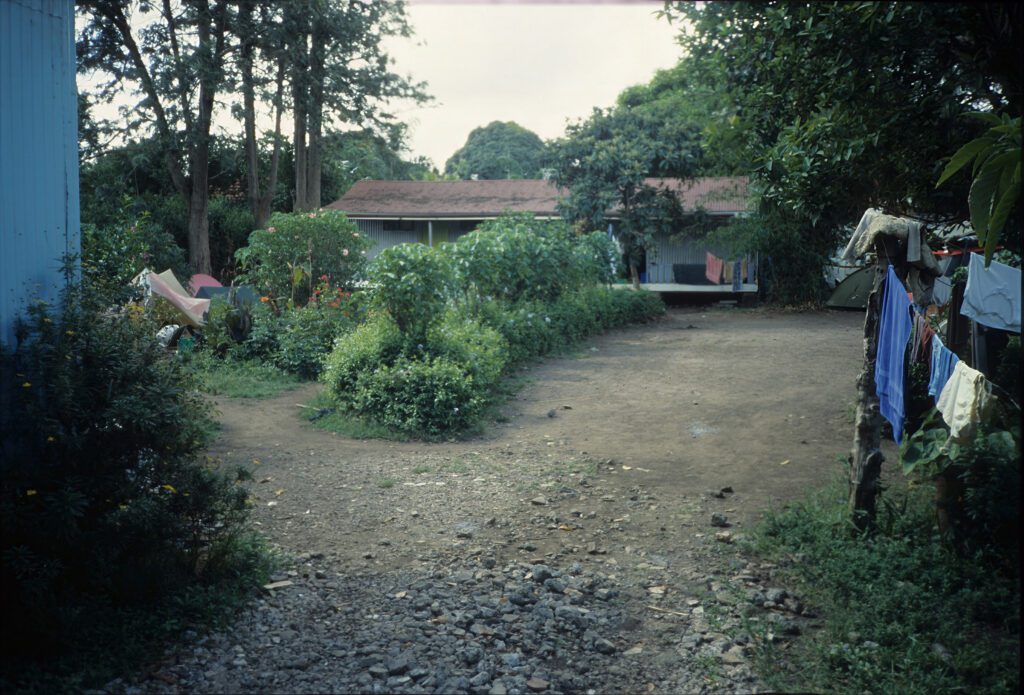
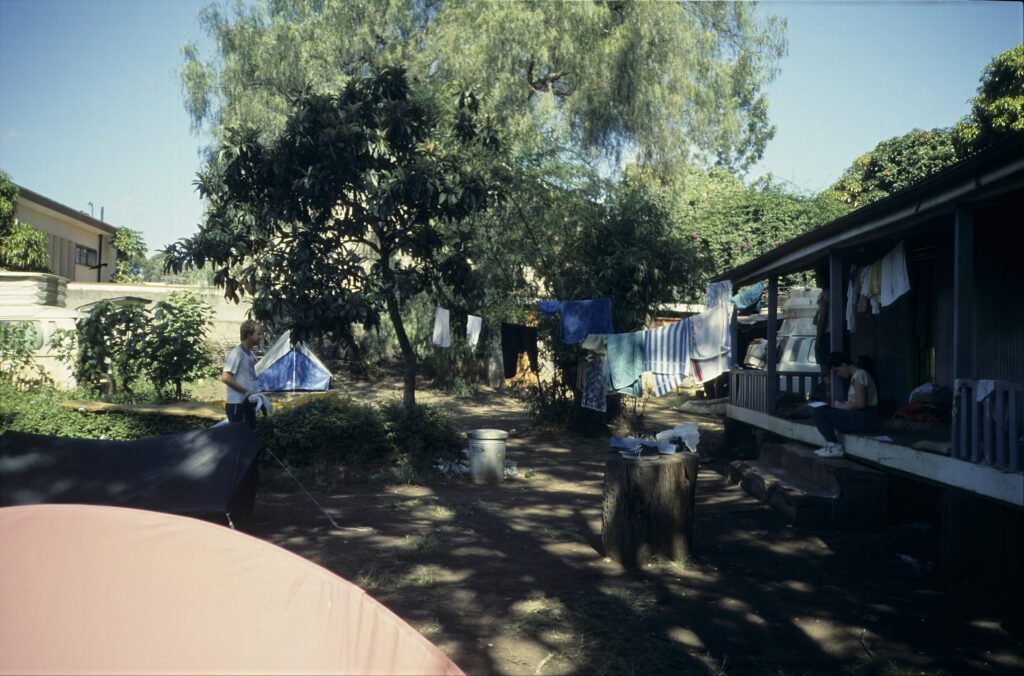
Continuing north, the neighborhood grew more orderly, with simple houses. On Third Parklands Avenue, the taxi dropped us off in front of a pair of large, solid-metal gates. Behind them lay Mrs. Roche’s place, which sat on a little less than two acres. In the center stood a small cottage. A wood-and-corrugated-tin bunkhouse was behind it. Clothes were drying everywhere. Trees and bushes covered most of the yard, and nearly every open patch of greenery held a backpacker’s tent.
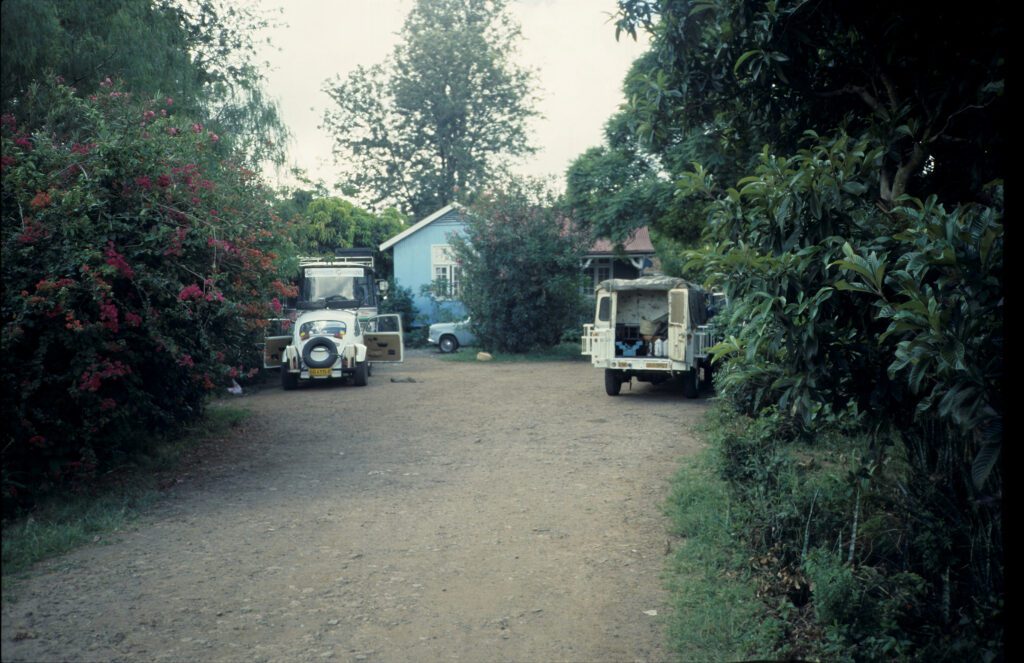
A few people lounged on the wide veranda in front of the dormitory, talking and laughing. Others drifted around the yard. One man was trying to reassemble a motorcycle while another stared into the open hood of a Land Rover, as if waiting for it to explain itself. Tools lay scattered in the dirt. A radio played somewhere out of sight.
A couple of tired-looking dogs trotted up and sniffed us. One of them sneezed, and they moved on.
As we approached the veranda, the conversation thinned. People looked up.
“This feels like a fraternity, and we’re the pledges,” I whispered to Vivian.
“What’s a pledge?”
Before I could respond, we arrived at the veranda.
“Good morning,” I said. “Do you know where we check in?”
A man with a Dutch accent replied, “Just go to the cottage over there. Mama will take care of you.”
“Mama? Is that Mrs. Roche?”
“Mama is what everyone calls her, but she’s not your mama,” he said. I must have looked confused. “The Russians sent her family to Siberia after they took over Poland. They made their way from Russia to Kenya during the war. She’s tough.” He paused. “But she does look after us.”
We found Mrs. Roche in the kitchen of her cottage. A serious woman in her early sixties with a Polish accent, short and a little overweight, sized us up and apparently decided we wouldn’t cause trouble. Then she smiled and welcomed us. Opening a book, she wrote something in it and asked us for thirty shillings each.
We paid and found a pair of beds next to each other—cheap, clean, and safe, but with no privacy. Vivian and I exchanged a look. Someone with Christmas spirit had tacked a red hiking sock to the wall.
After waking early the next morning, we stepped outside onto the veranda. At 6,000 feet above sea level, the air was crisp and dry, lacking the jungle humidity we expected from a city on the equator. The smell of dust, people, and diesel had faded overnight, but the town was coming alive, and the day’s fragrances would soon return.
A few backpackers were handwashing their clothes and hanging them out to dry. About half a dozen others, mostly in their twenties, sat on the veranda, lounging on the steps and pieces of furniture that looked as if they had been pulled from a trash heap. These were the so-called “porch dwellers,” an ever-changing group of experienced backpackers from different countries who held court as they shared stories of broken axles, bouts of dysentery, and the best way to bribe officials in East Africa.
“Fletch’s my name,” said one fellow with an Australian accent. “Where’re you from?”
“I’m Vivian, German-Argentine,” Vivian replied. “He’s Parker, American. We just arrived from Egypt.”
“Did you hear of anyone going through Ethiopia? It’s hard to get good information,” said another man with a French accent.
When Vivian mentioned that we had heard the overland route through Sudan was too dangerous, a couple of young German men, whose clothes were covered in oil and grease, laughed. “The Sudan was no problem. We drove to Kenya through Khartoum and Juba,” one said, pointing to a VW Beetle with three spare sand tires on its roof and rear. The suspension had been modified to handle rough and nonexistent roads. Two twenty-liter jerry cans sat in brackets welded to the frame. The car was partly disassembled, looking like something from Mad Max meets the Love Bug.
“We were told they’re killing any Whites they find,” Vivian said. “They have to catch us first. We go back to Germany the same way.” A few days later, they were gone.