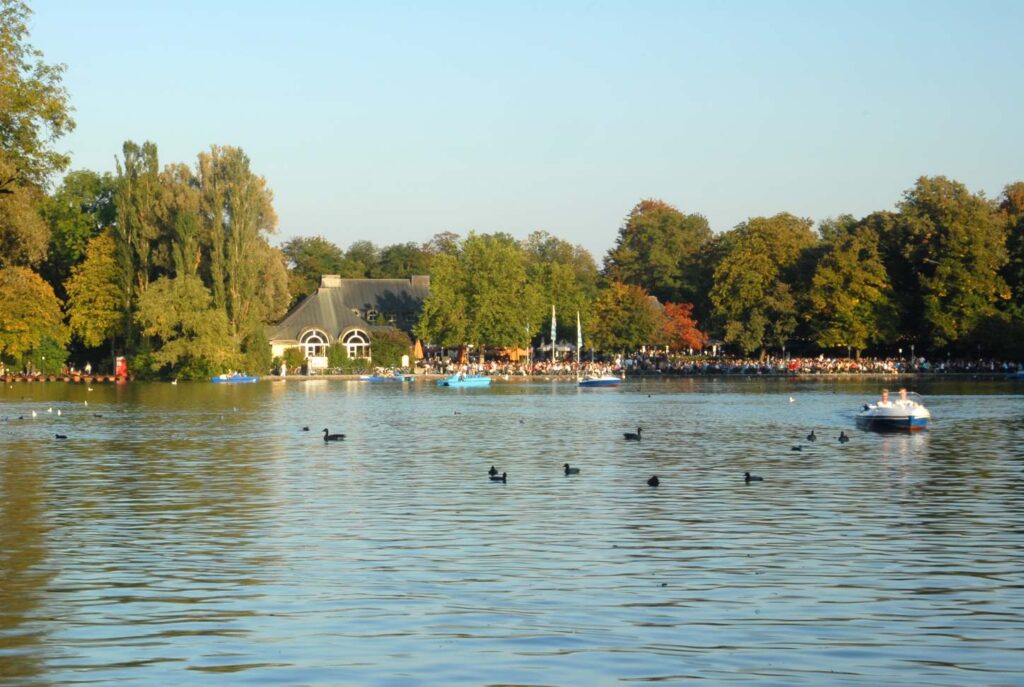
A week later, Vivian and I walked to the small Kleinhesseloher See at the north end of the Englischer Garten, rented a paddle boat, and floated around, mostly annoying the quacking ducks, who were offended by our presence.
“We signed the Philips contract yesterday,” I said. “It looks like I have a real business now.”
“Congratulations.”
She kissed me on the cheek. “Your father should be proud that you’re not a bobo.”
“Yoho,” I corrected.
I had told Vivian about the word my father claimed to have invented. He always said there were only two kinds of people in the world: con artists and yohos. Con artists ate yohos alive.
“Nothing I do here in Germany will change his mind,” I said.
“Maybe he’s prouder than you think.”
I looked up at the trees surrounding the lake and remembered being soothed by the gentle motion of the leaves when I was young. “You told me a story. Shall I tell you one? Careful, it might bore you.”
She laughed. “Nothing about you could bore me.”
I checked whether she was being sarcastic, then began telling the story.
“My father served three years in Africa and Italy during World War II and came home with demons he kept entirely to himself. He turned to alcohol as his escape. My mother couldn’t control him and withdrew into her own world. My older sister, Madelyn, ended up listening to his drunken rages until she went to college. For the next four years, it was my turn to listen to him complain: that we kept him tied down by obligations, that we kept him from traveling, that he couldn’t pursue an education because of us.”
“Most of the time, I just nodded as he talked to himself. Then one night, a few weeks before I left for college, I asked him why he had children. We seemed to have ruined his life.”
“I remember that he looked at me as if he’d forgotten I could speak. In a drunken slur, he replied, ‘My mother told me I had to start a family or I’d be unhappy and alone.’ He stared at me through half-closed eyes. ‘I believed her.’”
“My grandmother was strong on duty and the heavenly rewards that come from suffering in this life. My father worshipped her memory.”
“I should have kept my mouth shut. Instead, I asked, ‘You mean she conned you?’”
“The table went up, and he was on me. He threw me across the room and I hit the wall hard enough that the wind was knocked out of me. I remember my father’s face inches from mine, stale beer on his breath as he shouted, ‘Never talk about my mother that way!’ I braced for the fists to come.”
“Suddenly, a miracle occurred. Mom appeared. ‘Bill, calm down,’ she said softly. ‘He didn’t mean anything.’”
“The rage in his eyes faded, but the drunken anger remained. ‘Parasites,’ he said, ‘you’re all parasites. I’m leaving. This is the last you’ll see of me.’
“With that, he grabbed the car keys and left. My mother and I stood there quietly as Dad backed out of the driveway. Once we were sure the storm had passed, we began cleaning up.
“I realized two things as I was down on my knees picking up broken glass. Any woman I would be with had to be strong, someone who could protect herself and those around her. That’s why I appreciate you so much. You’re a strong woman. You can take care of yourself.”
I glanced at Vivian, but couldn’t read her face, so I continued, “My sister used to ask Dad whether he was a yoho or a con artist. I thought she was just pushing back, but that evening I finally understood. Dad was a yoho. So was my mother. Locked in a life of misery, conned by this mythical thing called love. That night, I swore I would never be a yoho.”
I fell silent, and we drifted with the wind. After a while, Vivian asked, “You don’t believe in love?”
“Believe? I’ve never seen a proton, but I believe it exists because everyone says it does. In any case, love doesn’t seem to end well. Isn’t that what you learned from your parents’ divorce?”
Vivian gripped my arm tightly. “I believe in love. It just seems to come with an expiration date.” We paddled around, heading back to the dock only because the rental office was closing.
The story continues every Thursday. Join us.