In May, Vivian’s mother, Astrid, called from Buenos Aires. “Good news!” Vivian exclaimed with a smile after she hung up. “Mutti’s coming to visit at the end of the month. She’ll stay with us, of course.”
“Of course,” I replied, swallowing hard.
While Vivian was happy to have her mother visit, I constantly felt scrutinized. That I had all my hair, a good education, and ran a business was positive, but not being German seemed to overshadow everything.
During the second week of her visit, I came home from work to find Astrid on the balcony, soaking up the late-spring sun and reading a book. After saying hello, I found a bottle of red wine, poured two glasses, and offered her one.
She thanked me, took a sip, and said, “You seem happy together.”
“Vivian is a remarkable woman. I’m lucky to be with her.”
“Yes,” Astrid replied. As when we first met, she said the word slowly, with a downward inflection at the end. “Perhaps you can tell me what your intentions are regarding my daughter?”
My wine went down the wrong way, and I started coughing. Astrid patiently waited for me to recover, and I finally choked out, “Sorry, I wasn’t expecting that.” I coughed again. “You mean marriage?”
She nodded.
I decided that while I might not be German, I could be just as direct. “It’s not really my choice. She says the men in her family don’t have a great track record for marital fidelity, that relationships have an expiration date, and she won’t be dependent on a man.”
Astrid looked down. “Is that what she says?”
“Yes. She doesn’t want to end up raising three children alone, as you did.”
“Ah,” she sighed. “We tried to make it easy for them, but sometimes …” She didn’t finish her thought. Instead, she took another sip of wine and said, “Four.”
“Four? Four what?”
“Four children. Of anyone, Vivian should include Tomás.”
I was confused. “Vivian has a brother?”
“She never mentioned him?” It wasn’t a question. She already knew the answer.
I said no, and she looked off into the distance.
“A wonderful boy. I remember it was a cold, bright late-winter day. Jürgen had just started his practice; we were in a small place then, but we had a girl to help with the house. While I was out, she was doing the laundry in the garage and had put Vivian in the doorway to keep an eye on her while she worked.
“Jürgen had stained a jacket during rounds the day before at the Hospital Alemán (German Hospital). We used benzene as a cleaning fluid back then. The girl opened the bottle, then realized she’d left her gloves in the house. She was only gone for a minute. But Tomás… he must have walked in as she left.”
Astrid paused. “Benzene vapor is explosive in a small room. We never found out what ignited it. The police said a nail in the heel of his shoe might have struck a spark on the stone floor.”
Astrid looked beyond the balcony, her face unreadable. She must have told this story many times, but it clearly never got any easier.
Just then, the front door opened. Vivian joined us, kissing her mother on the cheek. “Drinking already, I see,” she said with a small smile.
I poured her a glass as Astrid examined her. “I was just telling your novio about Tomás,” Astrid said.
Vivian’s smile vanished.
“Thankfully, you were blown onto the grass,” Astrid continued, reaching for Vivian’s hand. “That big rag doll you were hugging and your winter coat… they saved you. But the backs of your little hands were badly burned. I remember you running around with them wrapped in white bandages for weeks, so patient for someone so young. We were thankful we still had you.”
She turned Vivian’s hand over, her thumb tracing the skin. “You can still feel the scars.”
Vivian pulled her hand back. “Why talk about such things? They’re depressing, and there’s nothing we can do about them.”
Astrid smiled politely and said, “Yes, of course,” then changed the subject.
Later that evening, as Vivian and I were getting ready for bed, I asked, “Do you remember Tomás?”
Her face went blank. “Of course. I miss him even now.” She seemed to shiver. “When they closed him up in that box all alone, I screamed for them to let him out. Mutti had to take me away from the service. Afterward, I couldn’t believe he was there and told myself he had gone to a secret, faraway place that only he and I knew about. I imagined him having adventures, maybe as a sailor or working on the waterfront. I swore that someday I’d go there and find him.”
“Do you remember the accident?”
“Yes.” She looked down. “If I think about it, I go crazy.” Her face hardened. “Why bring this up? It changes nothing.”
I took her hand and stroked the back where the scars were barely visible. “Because it’s part of you.”
She pulled her hand away and said, “I don’t want your pity.” Then she got up to say goodnight to her mother.
In late June, with the summer solstice just a few days away, I invited Vivian to join me north of the Arctic Circle to see the midnight sun at Nordkapp, the northernmost point in Europe.
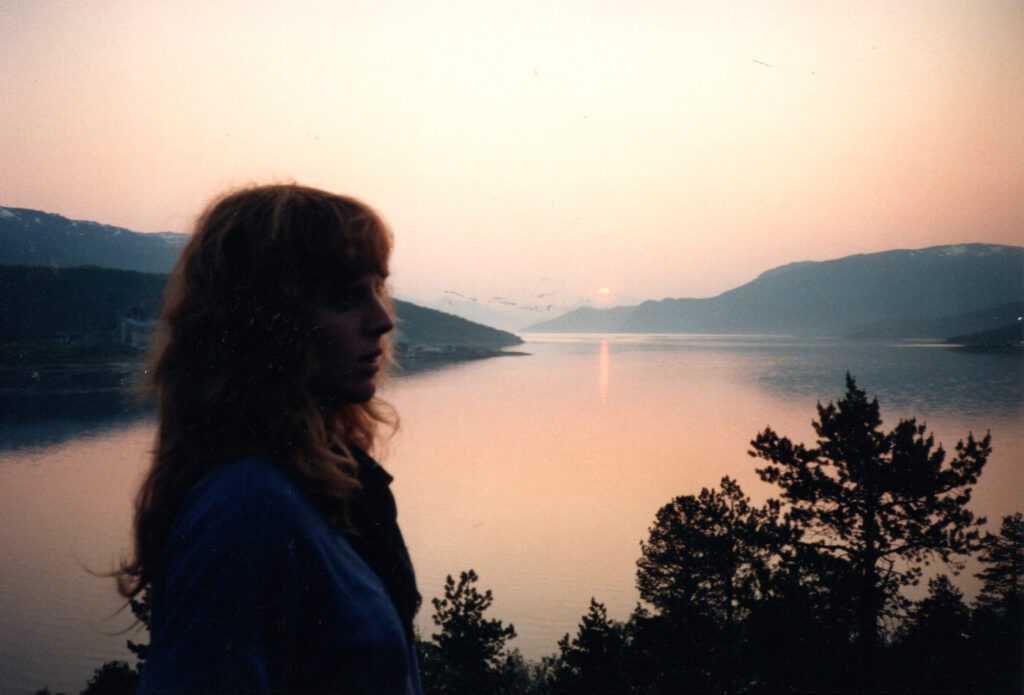
We flew to the Norwegian city of Bodø and drove for two days to Tromsø, 350 kilometers north of the Arctic Circle. On Sunday, the longest day of the year, we headed northeast toward Nordkapp. Just before midnight, we reached the southern end of a fjord that stretched north toward the Barents Sea. Towering cliffs rose sharply on both sides, their tops still covered in snow. With almost no wind, the sun, partly hidden behind a distant cloud, reflected off the calm waters to the north. We stopped by the side of the road and found a flat rock. Vivian held my arm as we sat side-by-side, watching the sun, framed by the fjord, dip low over the horizon before rising again.
“I imagine this is what Ushuaia is like,” Vivian said.
“What’s Ushuaia?”
“The very south of Argentina. It’s where I imagined Tomás went to have his adventures.”
“Is Ushuaia in Antarctica?”
She let go of my arm. “No. It’s in Tierra del Fuego on the Canal de Beagle (Beagle Channel). The southernmost city on Earth. In Argentina, we call it El Fin del Mundo, the End of the World.” She looked at me and saw I was still confused. “Don’t they teach you anything about the rest of the world in the US?”
“Ever heard of Peoria?” I asked.
“No. What’s Peoria?”
“The northernmost part of Illinois. We call it El Fin del Farmlandio. Don’t they teach you anything about the rest of the world in Argentina?”
“Don’t make fun of me. I always imagined Tomás living there, and someday I’d find him. When I told him how much we all missed him, he’d come home.” She looked at me. “I know it’s not rational.”
“It’s a wonderful fantasy,” I replied. “It’s like when your parents tell you that your dead dog went away to a farm to play with the other dogs. Sad that it’s not that simple.” Then I tried again to picture where Ushuaia was, but failed. “Is Ushuaia below the Antarctic Circle? Can we see the midnight sun there?”
“No, but it doesn’t get completely dark at night during the solstice. The region is beautiful, with the Andes, hiking, and wild country.” Her eyes met mine. “Someday I will take you there, and you will come with me.”
“Of course,” I replied. It was a throwaway promise that would come back to haunt me.