Swimming in Air: Week 4
Weeks later, we met at a café in the city center. I had missed my regular lesson, and she agreed to a makeup session on Saturday morning — professional and public, she insisted. When she arrived, she crossed the room with an easy self-confidence that turned heads. Mine included.
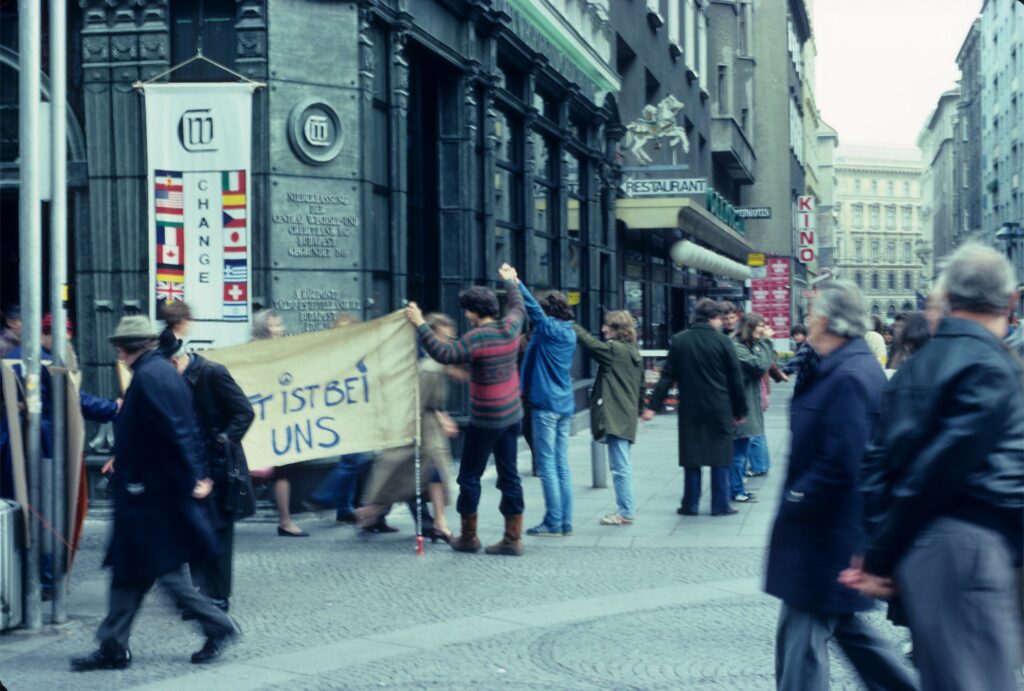
As I struggled with German grammar, a group of anti-nuclear protesters gathered in the square, waving signs denouncing President Reagan’s plan to deploy Pershing nuclear missiles in Germany.
“You should stay here until they leave,” she suggested. “It could go badly if they find out you’re from the United States.”
When the lesson ended, she said, “The demonstrators are still here. I can stay longer and keep you company if you’d like.”
“Yes, but only if you let me buy you lunch.”
After we ordered, I asked, “Do you mind if I ask a personal question?”
“It depends on the question,” she replied, leaning back in her chair.
“What’s your first name?”
She laughed. “Vivian.”
“Well, I’m Parker.” I reached across the table and we shook hands. “Nice to meet you. I promise to forget it by our next lesson.”
Apparently satisfied with the compromise, she leaned forward again.
“You said you moved to Germany a few weeks ago,” I continued. “So did I. What brought you here?”
“I have both German and Argentine passports, so I can live wherever I want. There was an opening at the Goethe-Institut. They liked that I was bicultural and a native German speaker.”
“You’re both German and Argentine?”
She nodded.
“Which are you first, and which second?”
“How do you mean?”
“Well, the 1986 World Cup starts soon. Everyone seems to think Argentina and Germany will reach the finals. If that happens, who will you root for?”
“My mind is German, but my heart is Argentine.”
“And…?”
“Of course, I’ll wear the blue and white of Argentina.”
As she spoke, her formality softened and slipped away.
“What was it like growing up Argentine in a German colony?”
“I learned German at home and Spanish in the streets. Being bilingual sounds impressive, but it’s like sitting on a stool with two legs. I still struggle with the subtleties of Cervantes and Goethe. When I switch between German and Spanish, I think differently. German is very structured, and verbs often come at the end of the sentence, so you can make a late decision about how strongly to make your point. Spanish is much freer, but you commit the verb earlier.”
I reminded myself to not try explaining quantum mechanics to her.
“And because most of the German colony came to Argentina in the late 1800s and early 1900s, people here laugh when I occasionally use an expression that hasn’t been current since the 1920s.”
“Like saying ’23 skidoo’ in English?” I asked.
“I don’t know what that means.”
“It means to leave a place quickly.” I motioned out the window. “Speaking of which, the protesters have moved on, so we can go.” By the end of the morning, I had invited her to dinner, received a lecture on professionalism, and been firmly dismissed as her student.
I’ll share the journey every Thursday. Join us.