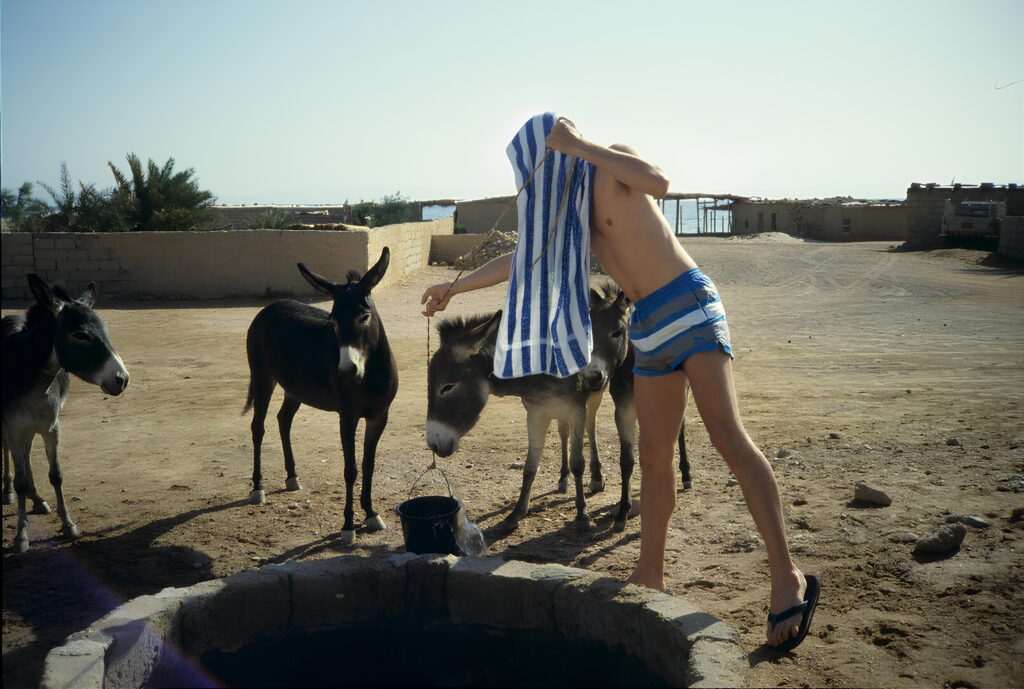
What follows is a scene that didn’t make it through editing — not because it isn’t true, but because you can’t tell everything. If it’s more than you want to know, feel free to skip it and come back next Thursday.
During our stay in the Bedouin village of Dahab on Egypt’s Gulf of Aqaba coast, we became friends with our host, Sheikh Ali. One evening, Vivian and I stayed up past midnight around a fire with Ali and a Coptic mystic named Mr. Williams; the Copts are one of the oldest Christian communities in the world. The sky looked full of shooting stars in the shimmering desert night.
Williams had spent seven years studying an Ethiopian tribe he called the Tribe with No Morality. “Those who follow the tradition don’t see murder as wrong. Each year they decide how many people the village can support, and then they kill children who they declare cursed until they reach that number. It’s usually an infant. Someone takes it to a river and drowns it or simply exposes it for the hyenas to take. I’ve come to believe there are no absolute truths.”
Sheikh Ali, quiet until then, said, “There is truth and it is written by Allah, but Allah may write truths we don’t see unless we open not only our eyes but our hearts.” We sat silently and watched meteors streak across the night sky.
I sometimes wonder if God expelled Adam and Eve from Eden not because of an apple, but because he wanted them to move on with their lives. Our departure from Dahab, though not exactly biblical, took us deeper into the desert. We caught a bus about 100 kilometers west into the heart of the Sinai Peninsula, where St. Catherine’s Monastery is located at the foot of Mount Sinai. The Germans call Sinai der Moses-Berg, or Moses Mountain, because it’s the place where the Bible says Moses saw the burning bush and received the Ten Commandments. St. Catherine’s housed around twenty Greek Orthodox monks, who confidently claimed that Mt. Sinai was the only place on Earth where God had walked, strangely forgetting Jesus.
The monks operated a hostel attached to the monastery, where we stayed with about a dozen others. Most of us were planning to make the seven-kilometer, twenty-five-hundred-foot climb up Mt. Sinai the next morning to watch the sunrise. Woken up well before dawn, we had a quick breakfast and began the two-and-a-half-hour ascent in the crisp December desert air. The nearly moonless sky was clear and starry. With our flashlight off, we were amazed at how much we could see by starlight alone. Just after five, with nearly an hour until sunrise, we reached the summit. A brisk wind met us there.
“Flaco, I’m freezing,” Vivian said. Our sweat-soaked cotton clothes were pulling the heat from our bodies.
“Come here,” I said.
Hugging her only succeeded in flattening the insulation of our jackets. In the darkness nearby, someone prayed for a burning bush. Around 5:30, the rosy fingers of dawn began to light up the east. A sliver of waning moon hung in the sky. I don’t remember much else of the beauty of that morning. Suddenly, an enterprising young Egyptian appeared selling hot tea. About twenty people crawled from crevices, between rocks, and any available windbreak. The tea was double the normal price. Everyone was rich. Give me two. No, three. As we drank, the warmth moved from our insides out. Sensation returned to our hands, and we remembered why we made the climb.
The sky brightened, and soon only a few of the brightest stars were visible in the west. Then the sun rose, initially obscured by distant clouds over the Gulf of Aqaba, then eventually broke free entirely. Brilliant and blinding, I wondered if it was the true burning bush. As we warmed, I understood why the first deities were sun gods.
Thirty minutes later, we began our descent down the mountain and marveled at the rugged terrain we had crossed by starlight. After collecting our packs from the dormitory and while waiting for the one o’clock bus to Cairo, we wandered through the parts of the monastery open to visitors.
We first met Father George, a middle-aged Greek monk with a quick wit, a good grasp of English, and a phenomenal beard. He offered us tea and exchanged pleasantries. We were soon joined by Brother Michael, an American originally from Utah and formerly of Tibet. He told us about monastic life, the history of St. Catherine, and his ongoing search for the truth that Mr. Williams said didn’t exist.
Some questions follow you across continents.
The journey continues every Thursday. Join us.