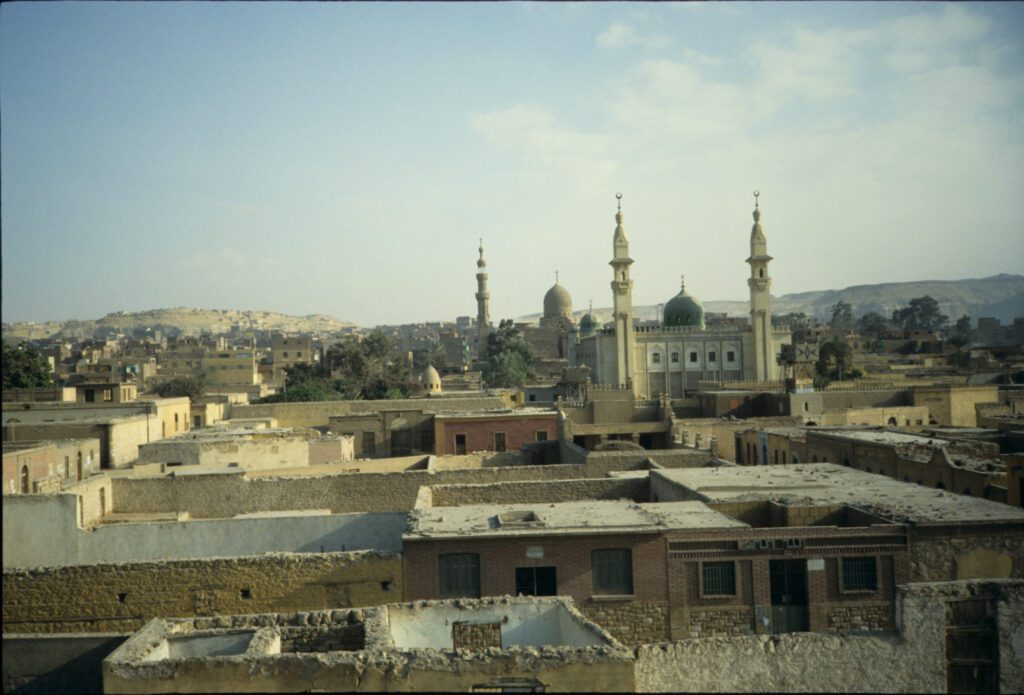
We were jolted awake by a loud, mournful wail from just outside our window. Vivian sat upright, wide-eyed. “What’s that?”
“I think it’s the first call to prayers.”
“Are you sure it doesn’t have anything to do with the soldiers we saw everywhere last night?”
I wasn’t sure of anything, but I said, “Don’t be silly. Of course not.”
Vivian drifted back to sleep, but I lay there waiting to see if I was right. After a few moments, the wailing stopped.
An hour later, noise from guests on the other side of the paper-thin walls woke us again. In the breakfast room filled with backpackers from around the world, we sat at a shared table next to a German man, and Vivian struck up a conversation. Soon, he pulled out a copy of Lonely Planet’s Africa on a shoestring by Geoff Crowther. He told us that Crowther’s guides were the gold standard for budget travel.
Quickly skimming the section on Cairo, Vivian saw that our hotel was listed at only four dollars a night. “Look here,” she said, pointing. “For eight dollars, the Grand Hotel around the corner has working toilets and hot water.” That sounded good, so we finished breakfast and checked out.
In downstate Illinois, assembling a crowd for anything other than church was impossible unless there was a house fire. I had been to many large cities since then, but even Tokyo hadn’t prepared me for the sheer mass of humanity in Cairo. We had to push our way onto the sidewalk, shoulder to shoulder with Egyptians in robes and in suits. The cacophony of honking cars competed with the classical Arabic music blaring from shopfronts. The air reeked of sweat and diesel, though it also smelled of baking bread.
I turned to Vivian and only half-jokingly said, “With a fast taxi and a good airline connection, we could be back in Athens in a few hours.”
“Live the dream, Flaco,” she said as she parted the crowd, a redheaded force of nature wearing a backpack.
At the Grand’s front desk, Vivian complimented the manager on the hotel’s beauty and cleanliness, noted that it was still early in the day, and mentioned that a dozen other hotels were nearby. Furthermore, she noted, we would be in Cairo for at least a couple of weeks, making us ideal long-term guests. If he offered us the eight dollar rate quoted in the guidebook, it might tempt us to stay. The manager explained that, due to inflation, prices had skyrocketed since the book’s publication. Besides, he told us, the Grand was an incomparable gem among Cairo hotels. Because we seemed like nice people, he would break the rules and give us a rate of only fourteen dollars. I watched as the two finally agreed on ten dollars a night.
After dropping our packs in the room, we headed out onto the street to find lunch. Every block, someone called out to us. Men, whom we later learned were called “tourist herders,” chatted us up, trying to steer us toward tea at a perfume shop. Politely declining, we reached the Nile after a half-hour walk, found a café, and Vivian began my education. “Lesson number one is to bargain for almost everything,” she said. “No one takes negotiating personally. In fact, it offends them if you don’t try.”
“That would be seen as aggressive in the US.”
“That’s because you people are too rich. Just watch me. You’ll get used to it.”
After finishing our meal, we wandered through the markets, where I found that, for Egyptians, bargaining was as much entertainment as business, and negotiating with this charming young woman was a fine way to pass the afternoon. In her element, Vivian haggled good-naturedly with the vendors, while always making her point.
After one particularly lively back-and-forth, a vendor at an open-air stall turned to me and said, “This woman, yours, yes? One hundred camel. Good price. Yes?”
I turned to “this woman, mine” and said, “Seems like a fair first offer. Do you want to negotiate this one?”
Vivian pointed at me and asked the man, “How many camels for this ass?”
Over the next few days, we learned that Egyptian street vendors considered Australians the cheapest tourists on the planet. When a hawker approached us with the usual opening question, “Meester, where you from?” I would respond in my best fake Australian accent, “We’re Australian students, mate.” Since most street hustlers’ English was limited, I probably didn’t need to fake an accent, but being both Australian and a student was usually enough to send them off.
One day after walking for miles, getting lost on city buses, and fending off street vendors, we returned to our room, exhausted. The next morning, I told Vivian I wanted to relax at the hotel. We had found an English-language bookstore, and I planned to lose myself in a pulp novel. Not wanting to “waste” the day, she went off to explore the city on her own. That afternoon, she wrote in her diary, as she often did, in a mix of German and Spanish, translated below.
So gegen elf gehe ich auf die Straße … So around eleven, I head onto the street, my first day alone. Glancing at the city map attracts a very elegant dark-haired man. “Parlez vous Francais?” I want to be alone, so I lie and say no. “Je regrette,” he says, that we must speak simple French and accompanies me while I walk. I tell him about my boyfriend. He insists on writing his phone number in The Cairo Book. I should call him later in the day and we can meet at my hotel. I explain that it will be difficult because my boyfriend doesn’t speak French. Pas de problème. He says goodbye until then.
I find myself at the wrong bus stop and open The Cairo Book. Men surround me speaking very quickly in Arabic. Am I really communicating such pitiful helplessness? I escape to a bus and a young man feels the need to get on with me. “I help you.” He talks about the studies he is pursuing, has finished or is just beginning. It’s not clear. His constant chatter, his faulty, often absolutely incomprehensible English makes me feel slowly suffocated. I go past my bus stop, get out and he buys two new tickets. “In Egypt a woman pay no beautiful.” I thank him and he gets excited. He wants to marry me. We could even have children. I mention my boyfriend for the thousandth time. He writes his phone number in The Cairo Book, suggests we meet at my hotel, and bids me goodbye.
That evening over dinner, Vivian summarized the day: “Egyptians are generally wonderful, but when it comes to women, the men act like little boys grabbing for candy.”
A Dutch woman we were sharing a table with was horrified. “Never talk to men on the street.”
“That seems awfully harsh,” Vivian replied, “I know it’s annoying, but they seem harmless.”
“You think so? Egyptian men think we’re no better than prostitutes, wanting nothing more than to jump into bed with them. Last week, a Danish woman staying here politely answered a man’s question as she walked back to the hotel. He followed her into the elevator and tried to kiss her. She screamed, and when the elevator door opened, the Arab men on the floor beat him to a pulp before handing him over to the police. The poor woman was so traumatized that she flew home immediately. My advice is to put those tight blue jeans away. Cover your T-shirt with some loose clothing. And go to a jeweler and buy a wedding ring.”
Vivian didn’t reply.
“A wedding ring?” I asked.
“Yes,” she replied, turning to me. “You too. It will make things simpler if you look married.”
The next day, we found a couple of cheap wedding rings, which Vivian got for half the asking price.
Of course.
The story continues every Thursday. Join us.