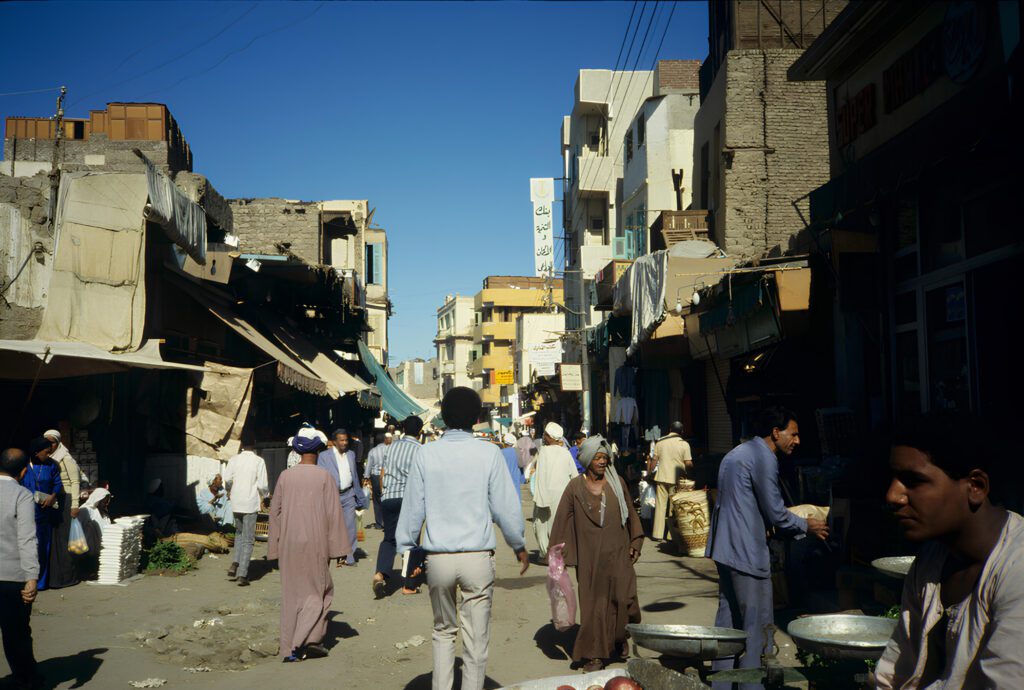
Backpacking on a budget, you often have no clear idea where you will end up or how long it will take you to get there, but that’s part of the adventure. The best information usually comes from travelers heading in the opposite direction. Next, but necessarily out of date, are travel guides like The Cairo Book. Finally, there are times when you have nothing to go on. We didn’t know it yet, but that evening was one of those times. We only knew where the path started.
In mid-October, we found airline tickets at a bucket shop in Athens, bought a guide called The Cairo Book at the airport souvenir shop, and left on the late-afternoon flight for Egypt.
We exited Cairo International Airport into the warm, slightly humid night air, which smelled of diesel and jet fuel. An Arab man, leaning against a battered Peugeot 504, focused on the butt end of a cigarette, saw us, and pointed to the car. “Taxi! Where you want to go?”
“Midan Tahrir.”
He stubbed out his cigarette after taking one last deep drag. “I take you.”
As we were getting into the cab, Vivian asked, “Where is your meter?”
“No meter, madam. Fixed price. Set by government. Twenty pounds.”
That was about $12 US, which seemed fair to me.
Vivian smiled. “Give us a minute. I need to speak with someone at the tourist desk.”
The man looked surprised, then smiled back. “Just for you, I break rules. Fifteen pounds.”
Vivian wasn’t finished. “I think we should ask some of the other taxi drivers to see if we can get a better rate.”
Thinking deeply, he replied, “Okay, okay, twelve pounds. Where you go at Midan Tahrir?”
“We don’t know,” I said. “We need to find a hotel there.”
A smile returned to his face. “You look like good people. Ten pounds. Very late. Not safe. I take you to good hotel.”
“Is that near Midan Tahrir?” I asked.
His English suddenly failed him. We got in, and I looked for a seat belt, but all I could find was frayed webbing protruding from the cracked vinyl seat.
Arriving in Cairo, we found ourselves in a sea of buildings and a flood of lights. We passed by the occasional restaurant where men sat around smoking water pipes, playing what looked like backgammon, and talking loudly to each other. Our driver weaved through traffic, honking his horn as if he owned the road. We eventually stopped at a hotel with a hand-painted sign in English and Arabic. I read the name and checked The Cairo Book. It wasn’t listed.
“This my cousin,” the driver said. “He give you good room. Very cheap.”
We stepped out of the taxi into a quiet residential neighborhood, where the air was filled with the scents of spices and dust. The driver led us to the reception desk, where he had a brief chat in Arabic. We paid him, and he left.
The desk manager smiled and offered us a room for $30.
By now, it was already past ten, and I was willing to pay twice that to get off the street. “Let’s just take it,” I said.
“Flaco, no,” Vivian replied. “Never accept the first price.”
She began haggling with the manager, who didn’t budge. He said he was already offering us a discounted rate and couldn’t go any lower. It was late, and the rooms he had left were his most expensive. He also had to pay the taxi driver a commission. As I watched the hands on the wall clock approach eleven, Vivian issued an ultimatum: “Give us a $15 rate, or we’ll leave.” She was not to be toyed with.
Five minutes later, we stood under a streetlight, squinting at The Cairo Book, with no idea where we were. I searched the sky in vain for any stars that might show us which way was north.
“That ended well,” I said. Vivian glared at me.
We put on our packs and started walking toward what I hoped was Midan Tahrir. We hadn’t gone more than a quarter of a kilometer when we came across three soldiers armed with assault rifles standing on a street corner. It wasn’t clear why they were there, but they were intimidating. We kept walking and saw similar three-man teams every few blocks. Aside from soldiers, almost no one was on the street, which wasn’t surprising since it was now late Wednesday night.
I told Vivian to walk as if we knew where we were going and to avoid making eye contact. Ignoring me, she approached an elderly Egyptian man in a skullcap and a wide-sleeved gallabiyah. She showed him the map from The Cairo Book and pointed to Midan Tahrir—which, of course, was written in English—and asked, “Tahrir?” He nodded in a direction and repeated, “Tahrir.”
“Shukran,” she said.
“What’s shukran?” I asked later.
“It means thank you. You should learn a little Arabic while we’re here.”
After another ten minutes of walking down winding streets that intersected at all angles, I told Vivian I thought we might be going in circles. Before I could stop her, she approached one of the three-man teams. No one spoke French, German, Italian, Spanish, or English. Vivian’s Arabic was nascent at best, so she pantomimed her question.
“Midan Tahrir?” she asked, her hands sweeping the horizon.
They pointed down a street.
Setting her palms apart, she asked, “Far?” Then she brought her palms together. “Close?”
The soldiers smiled and brought their palms close together.
Vivian put her hands together as if in prayer and said, “Shukran.”
The smiling soldiers nodded and replied, “Afwan.”
As we walked away, I said, “Let me guess. Afwan means you’re welcome.”
“There’s hope for you yet.”
Following a chain of pointing soldiers, we reached Tahrir Square, where we were quoted $10 for a double room with a shared shower and toilet. A quick walk through the hotel revealed that some rooms were little more than hallways with mattresses. Exhausted, we took it.
Just before 1 AM, we collapsed onto a double bed that looked like a wadi, the sometimes-moist depressions in the Egyptian desert. As I tried not to roll into the middle, I whispered, “Do you think it’s all going to be like this?” No answer. Vivian was already asleep.
The journey continues every Thursday. Join us.